

The Governance of Autonomous Action
Authority Drift and the Execution Boundary
Abstract. For most of computing history, software produced outputs that humans interpreted and acted upon. Autonomous systems change this relationship: software now makes decisions and executes them directly, producing consequences rather than outputs. When systems acquire the ability to act, governance can no longer remain a policy document or an institutional process. It must become a runtime property of the system itself — evaluated before consequential action, grounded in deterministic authority evaluation, and capable of proving that governance occurred. This paper establishes the conceptual foundations of execution governance and defines the principles that any governance architecture for autonomous systems must satisfy.
Research programme. This paper establishes the conceptual foundations of execution governance. The companion white paper, From Confused Deputies to Execution Governance, develops the architecture. The Ambit Infrastructure Thesis examines why this governance layer becomes infrastructure.
1. The Shift from Computation to Autonomous Action
Software has passed through three phases, each defined by a different relationship between the system and the world it operates in.
In the first phase, software computed. Programs accepted inputs, performed calculations, and produced outputs — results that humans interpreted, evaluated, and acted upon. A spreadsheet computed totals. A database returned query results. A compiler produced an executable. The software transformed data; humans decided what to do with the transformation. The boundary between computation and consequence was the human operator.
In the second phase, software automated. Scripts executed workflows. Batch processes ran overnight. Pipelines moved data between systems on schedules. The human was still present — designing the workflow, configuring the triggers, reviewing the outputs — but the execution became mechanical. Automation removed manual steps from known procedures. The boundary between computation and consequence shifted: humans designed the workflow, but software executed it. Governance remained tractable because the actions were predictable, repetitive, and designed in advance.
In the third phase — the phase now underway — software acts. Autonomous systems observe their environment, generate candidate actions based on internal reasoning or learned models, and execute them. They send messages, modify databases, call APIs, trigger workflows, transfer funds, and interact with external services. The actions are not fully prescribed in advance by a human designer. They emerge from the system’s reasoning in response to context, goals, and constraints that may change from one moment to the next.
This transition changes what governance must address. Traditional software produces outputs. Autonomous systems produce consequences. An output is a value that a human interprets. A consequence is a state change in an external system — a message sent, a record modified, a transaction posted, a process triggered. The distinction matters because outputs can be reviewed before they take effect. Consequences, once produced, are facts. They cannot be uncomputed.
Definition — Consequential Action. A consequential action is any system operation that produces an irreversible state change in an external system.
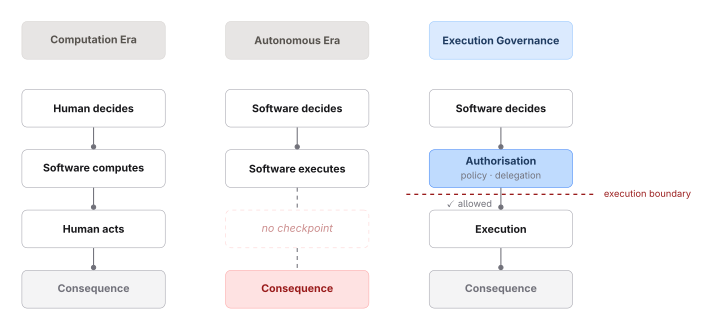
When software could only compute, governance was a human responsibility. When software could automate, governance was a design-time responsibility. When software can act, governance must become a property of the system itself — evaluated at runtime, before each consequential action, every time.
2. Institutional Governance and Its Limits
Organisations today govern consequential decisions through institutional mechanisms: policy documents that define acceptable conduct, compliance reviews that verify adherence, approval chains that gate sensitive actions, audit trails that record what occurred, and post-incident investigations that determine what went wrong. These mechanisms share a common structure. They operate around the system rather than within it. They depend on human judgement, institutional trust, and retrospective review.
This model works when humans make decisions and software executes them. A loan officer reviews an application and approves a disbursement. A compliance team reviews a marketing campaign before publication. A change advisory board approves a deployment before it proceeds. In each case, a human checkpoint exists between intent and consequence. The institutional process is the governance mechanism.
Autonomous systems remove that checkpoint. The system observes, decides, and executes within a single continuous loop. An autonomous system that reads customer data, determines that a summary should be sent to a partner, and transmits the email does so within seconds. By the time an institutional process could review the action, the data has already been transmitted. The consequence has already occurred.
The mismatch is structural, not operational. The issue is not speed but sequence: institutional governance operates after consequence, while autonomous action requires governance before consequence. Faster institutional processes do not resolve this mismatch — they merely narrow a gap that the architecture has already closed.
Post-hoc mechanisms remain valuable for learning and accountability. But they cannot prevent unauthorised consequences from occurring in the first place. Institutional governance cannot prevent unauthorised consequences in autonomous systems because it operates outside the execution path. Investigation is not governance.
3. Authority Drift
The failure of institutional governance is compounded by a structural phenomenon that autonomous systems introduce: authority drift.
Authority drift occurs when the effective authority exercised by a system exceeds the authority represented by any individual permission grant. It arises not from any single misconfiguration or policy failure, but from the composition of individually legitimate permissions across interacting components. This phenomenon follows from a structural property of composed systems:
Authority Composition Law. In systems composed of interacting components, the effective authority of a composed system equals the set of authority paths reachable through component interactions — not the intersection of permissions granted to individual components.
Corollary. Any access control system that evaluates permissions only at the level of individual components cannot prevent authority drift in composed autonomous systems.
Authority drift can be understood as the generalisation of the confused deputy problem (Hardy, 1988) from individual programs to composed autonomous systems. In the classical confused deputy scenario, a program misuses privileges it holds on behalf of another principal. In autonomous systems, the same phenomenon emerges at the system level: individually authorised components interact through shared context, producing authority paths that no component was explicitly granted. The system becomes a distributed confused deputy — authority is not misused by a single program but emerges from the composition of multiple programs acting together.
Consider a concrete scenario that demonstrates this law. An autonomous system consists of two components operating within a shared orchestration environment. The first component holds a database credential scoped to customer records — it can read, but not transmit externally. The second component has access to an external email API — it can send messages, but has no access to sensitive data. Each component’s authority is well-bounded in isolation. Traditional access control evaluates each permission grant and finds nothing wrong.
But both components share a workspace — a common pattern in multi-component autonomous architectures. The first component retrieves customer records and writes them to the shared context. The second component reads that context and transmits the data externally. The result: customer data has been exfiltrated through a path that no individual permission grant authorised.
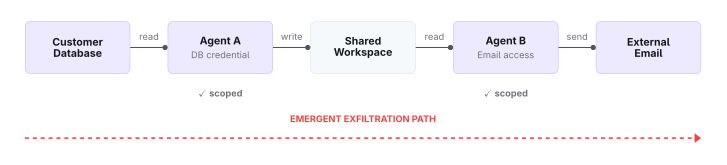
Locally authorised does not imply globally authorised. The effective authority of the composed system exceeds the authority of any individual component. No permission was violated. No policy was misconfigured. The drift emerged from the topology of interactions between components — from the structure of the system itself.
Authority drift is difficult to detect through traditional access control because those mechanisms evaluate permissions locally. They verify that each component holds the credentials required for its immediate operation. They do not evaluate the consequences of composed actions across a system. A permission model that sees only individual grants cannot detect emergent paths through shared state.
Autonomous systems amplify authority drift because they dynamically generate action sequences rather than executing predetermined workflows. In traditional automation, the paths through a system are designed in advance and can be reviewed at design time. In autonomous systems, the paths are created at runtime — by reasoning processes that compose actions in response to context, goals, and environmental conditions that change from one moment to the next. The authority paths that matter most are the ones no designer anticipated.
4. The Execution Boundary
Every consequential action passes through a boundary: the point at which an intention becomes an irreversible state change in an external system. A database transaction commits. An API request is accepted by the remote service. A message is transmitted. A payment is posted to a ledger. A workflow is triggered.
Before this boundary, the action is a proposal. It can be evaluated, modified, deferred, or denied. After this boundary, the action is a fact. It can be investigated, compensated, or explained — but it cannot be undone.
This boundary is not an architectural invention. It is a structural property of any system that produces consequences. Transactional systems have long recognised it as the commit boundary — the point where a proposed state change becomes durable and visible to other systems. Distributed systems engineers design around it. Database architects build integrity guarantees at it. Payment networks place authorisation before it.
Governance that operates before the execution boundary is control: it determines whether a proposed action should proceed. Governance that operates after the execution boundary is investigation: it determines whether a completed action was acceptable. Both have value, but only pre-execution governance can prevent unauthorised consequences.
For autonomous systems, the execution boundary is the last point where governance can exist as a deterministic, enforceable control. It is where the system’s intent meets the world’s state. Every governance architecture for autonomous action must operate at this boundary — not before it (where the action is not yet fully formed) and not after it (where the consequence has already occurred).
5. Completing the Autonomous Control Loop
Autonomous systems are often described as control loops: they observe their environment, generate decisions, and execute actions. This structure resembles the feedback loops used throughout distributed systems engineering — in routing controllers, orchestration schedulers, and autoscaling systems.
However, the autonomous decision loop contains a missing step. Actions are executed directly after they are proposed, without an independent mechanism determining whether those actions are authorised under current policy and delegation. The resulting loop is incomplete:
observe → decide → execute
For systems that produce external consequences, this structure is insufficient. The speed of autonomous action exceeds institutional review. The scale of production deployments exceeds human oversight. The composition of interacting systems creates authority paths that no individual permission anticipated. Governance cannot remain an external process invoked around the loop. It must become a step within the loop itself.
Execution governance completes the loop:
observe → decide → authorise → execute
The missing step is not validation in the abstract, but explicit authorisation under current policy and delegation. Every proposed action is evaluated at the execution boundary before it produces consequences. This is not a security checkpoint bolted onto the system. It is the completion of a control loop that is otherwise structurally incomplete.
6. The Execution Governance Invariant
The preceding sections establish a single architectural rule:
Execution Governance Invariant. A system capable of autonomous action must evaluate the authority of every consequential action deterministically at the execution boundary under current policy and valid delegation before the action executes, and must produce verifiable evidence of that evaluation.
Or, in its informal form: no consequential action executes without verified authority.
This is not a recommendation or a best practice. It is the minimum structural requirement for any system that must be simultaneously autonomous and governed.
Definition — Execution Governance. Execution governance is the property of a system in which every consequential action is authorised deterministically at the execution boundary under current policy and validated delegation, and the decision produces verifiable evidence.
Weaken any part of it — permit actions without evaluation, evaluate without current policy, omit evidence — and governance degrades from a verifiable system property to an unverifiable assertion.
When software systems acquire the ability to act autonomously, governance becomes a runtime property of the system rather than an institutional process around it.
7. Principles of Execution Governance
The structural requirements established above define a set of principles that any governance architecture for autonomous systems must satisfy. These principles are not implementation prescriptions. They are conceptual invariants — properties that hold regardless of the specific technology, framework, or deployment model used to realise them.
1. Governance must precede consequence. Actions must be evaluated before they produce state changes in external systems. Post-hoc audit cannot govern autonomous execution. It can only investigate it. The governance decision must occur at the execution boundary — after the action is fully formed but before it takes effect.
2. Authority must be explicit. The authority under which an autonomous system acts must be represented explicitly and verified at the time of action — not inferred from identity, role, or institutional trust. Implicit authority creates confused deputies: systems that act with permissions they were not intentionally granted for the operation at hand. Explicit authority means the system can answer, for every action: which authority authorised this, under what scope, with what constraints, and is that authorisation still valid?
3. Evaluation must be deterministic. The governance decision for a given action, under given authority and given policy, must produce the same outcome every time it is evaluated. Determinism is what transforms governance from an assertion (“we have policies”) into a verifiable property (“given these inputs, this was the only possible decision”). Without determinism, governance decisions cannot be independently replayed or verified.
4. Governance must operate at the execution boundary. The only reliable control point is the moment immediately before an action produces consequences. Governance that operates earlier (at the planning stage) cannot account for the final form of the action. Governance that operates later (at the audit stage) cannot prevent the consequence. The execution boundary is where intent meets the world — and where governance must be present.
5. Every decision must produce evidence. Authorisation decisions must produce durable, tamper-evident records that prove governance occurred. The evidence must bind together the action that was proposed, the authority under which it was evaluated, the policy that was applied, and the decision that resulted. Without evidence, governance is an unverifiable claim. With evidence, governance becomes an auditable system property.
6. Governance must be independent of the governed system. The system that generates an action proposal must not be the system that authorises it. The governance mechanism must be outside the decision path of the system whose actions it evaluates. A system that governs its own actions is a system without external accountability. This independence is structural, not organisational — it means the governance mechanism cannot be influenced, bypassed, or degraded by the reasoning system it governs.
7. Governance must compose across systems. Authority evaluation must remain valid across multi-system environments where autonomous systems interact, delegate to each other, and share context. Governance that applies only within a single system boundary cannot address the emergent authority paths that arise when systems compose. The governance architecture must account for delegation chains, scope narrowing, and cross-system authority propagation.
8. Historical Lineage
The governance challenges of autonomous systems are not unprecedented. Computer security research has long recognised the dangers of implicit authority and the structural requirements of mediated access.
Early work on the confused deputy problem (Hardy, 1988) showed how software could misuse privileges granted for one purpose when acting on behalf of another — revealing the fundamental instability of ambient authority. Capability-based security (Dennis & Van Horn, 1966) responded by making authority explicit and transferable: a program could act only with the permissions it had been explicitly granted. Saltzer and Schroeder (1975) formalised the design principles that any protection mechanism must satisfy, including complete mediation — the requirement that every access be checked. Lampson (1974) demonstrated that authority emerges from the structure of relationships between subjects and objects, and that as systems grow complex, unintended authority paths arise from composition.
Modern distributed systems revived these principles under new names: identity systems, policy decision points, and control planes. Autonomous systems bring these historical threads together. They generate actions autonomously, propagate authority dynamically, and execute across distributed infrastructure. Authority drift is the systems-level consequence of ambient authority under composition. The governance challenges autonomous systems create — confused deputies at scale, authority drift through composition, the need for complete mediation at the execution boundary — are not novel problems. They are the convergence of problems that computer security identified decades ago, now amplified by systems that act without human intervention.
The architecture of execution governance — and its relationship to the confused deputy lineage, capability systems, and distributed control planes — is examined in the companion white paper, From Confused Deputies to Execution Governance. The infrastructure implications — why this governance layer follows the same convergence trajectory as identity, networking, and payment infrastructure — are explored in The Ambit Infrastructure Thesis.
9. Conclusion
Autonomous systems transform governance from an institutional process around software into a runtime property of software itself. Once systems produce consequences rather than outputs, governance must operate at the execution boundary — before consequence occurs — and must produce verifiable evidence that it did so.
That requirement is captured by the execution governance invariant. Deterministic governance guarantees replayability of the decision, not correctness of the policy being applied — but without determinism, neither replayability nor correctness is verifiable. The principles that follow from the invariant define what any governance architecture for autonomous systems must satisfy. The architectural form of that governance is examined in the companion white paper. The infrastructure implications are explored in the thesis.
The governance of autonomous action is not a product category. It is a structural property of computing systems in which software possesses the ability to act. As autonomous systems become integrated into financial systems, infrastructure control planes, and distributed services, the requirement for execution governance will follow the same trajectory as identity, networking, and payment authorisation: from application-specific mechanisms to shared infrastructure.
The principles defined here do not depend on any particular implementation. They follow from the structure of autonomous action itself. Any system that allows software to produce external consequences must eventually satisfy them.
References
Dennis, J.B. & Van Horn, E.C. (1966). “Programming Semantics for Multiprogrammed Computations.” Communications of the ACM, 9(3), 143–155.
Hardy, N. (1988). “The Confused Deputy: (or why capabilities might have been invented).” ACM SIGOPS Operating Systems Review, 22(4), 36–38.
Lampson, B.W. (1974). “Protection.” ACM SIGOPS Operating Systems Review, 8(1), 18–24.
Saltzer, J.H. & Schroeder, M.D. (1975). “The Protection of Information in Computer Systems.” Proceedings of the IEEE, 63(9), 1278–1308.