

The Governance of Autonomous AI Action
Authority Drift and the Execution Boundary
Abstract. For most of computing history, software produced outputs that humans interpreted and acted upon. Autonomous AI systems change this relationship: software now makes decisions and executes them directly, producing consequences rather than outputs. When systems acquire the ability to act, governance can no longer remain a policy document or an institutional process. It must become a runtime property of the system itself — evaluated before consequential action, grounded in deterministic authority evaluation, and capable of proving that governance occurred. This paper establishes the conceptual foundations of execution governance and defines the principles that any governance architecture for autonomous AI systems must satisfy.
Research programme. This paper establishes the conceptual foundations of execution governance. The companion white paper, From Confused Deputies to Execution Governance, develops the architecture. The Ambit Infrastructure Thesis examines why this governance layer becomes infrastructure.
1. The Shift from Computation to Autonomous Action
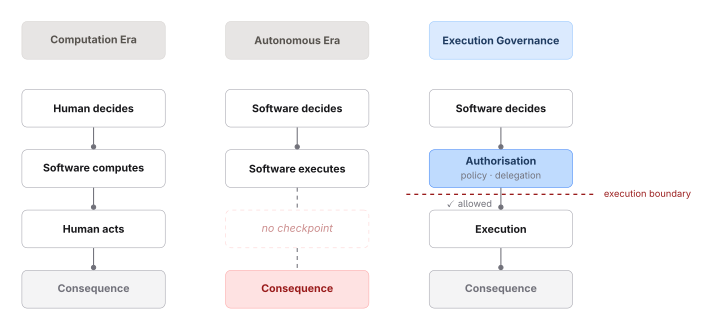
Software has passed through three phases, each defined by a different relationship between the system and the world it operates in.
In the first phase, software computed. Programs accepted inputs, performed calculations, and produced outputs — results that humans interpreted, evaluated, and acted upon. A spreadsheet computed totals. A database returned query results. A compiler produced an executable. The software transformed data; humans decided what to do with the transformation. The boundary between computation and consequence was the human operator.
In the second phase, software automated. Scripts executed workflows. Batch processes ran overnight. Pipelines moved data between systems on schedules. The human was still present — designing the workflow, configuring the triggers, reviewing the outputs — but the execution became mechanical. Automation removed manual steps from known procedures. The boundary between computation and consequence shifted: humans designed the workflow, but software executed it. Governance remained tractable because the actions were predictable, repetitive, and designed in advance.
In the third phase — the phase now underway — software acts. Autonomous AI systems observe their environment, generate candidate actions based on internal reasoning or learned models, and execute them. They send messages, modify databases, call APIs, trigger workflows, transfer funds, and interact with external services. The actions are not fully prescribed in advance by a human designer. They emerge from the system’s reasoning in response to context, goals, and constraints that may change from one moment to the next.
This transition changes what governance must address. Traditional software produces outputs. Autonomous AI systems produce consequences. An output is a value that a human interprets. A consequence is a state change in an external system — a message sent, a record modified, a transaction posted, a process triggered. The distinction matters because outputs can be reviewed before they take effect. Consequences, once produced, are facts. They cannot be uncomputed.
Definition — Consequential Action. A consequential action is any system operation that produces an externally-observable effect that cannot be fully retracted — including any change to persistent state in an external system, any transfer of data across a trust boundary, and any other externally-visible side effect. Disclosure or transmission of information qualifies even when the source state is unchanged, because the effect — the world having observed the information — is irreversible in itself. Compensatable changes qualify too: a database write or a ledger posting can be corrected by a later action, but the original effect remains a fact that occurred. The trigger is externalisation, not irreversibility of the source.
When software could only compute, governance was a human responsibility. When software could automate, governance was a design-time responsibility. When software can act, governance must become a property of the system itself — evaluated at runtime, before each consequential action, every time.
2. Institutional Governance and Its Limits
Organisations today govern consequential decisions through institutional mechanisms: policy documents that define acceptable conduct, compliance reviews that verify adherence, approval chains that gate sensitive actions, audit trails that record what occurred, and post-incident investigations that determine what went wrong. These mechanisms share a common structure. They operate around the system rather than within it. They depend on human judgement, institutional trust, and retrospective review.
This model works when humans make decisions and software executes them. A loan officer reviews an application and approves a disbursement. A compliance team reviews a marketing campaign before publication. A change advisory board approves a deployment before it proceeds. In each case, a human checkpoint exists between intent and consequence. The institutional process is the governance mechanism.
Autonomous AI systems remove that checkpoint. The system observes, decides, and executes within a single continuous loop. An autonomous AI system that reads customer data, determines that a summary should be sent to a partner, and transmits the email does so within seconds. By the time an institutional process could review the action, the data has already been transmitted. The consequence has already occurred.
The mismatch is structural, not operational. The issue is not speed but sequence: institutional governance operates after consequence, while autonomous action requires governance before consequence. Faster institutional processes do not resolve this mismatch — they merely narrow a gap that the architecture has already closed.
Post-hoc mechanisms remain valuable for learning and accountability. But they cannot prevent unauthorised consequences from occurring in the first place. Institutional governance cannot prevent unauthorised consequences in autonomous AI systems because it operates outside the execution path. Investigation is not governance.
3. Authority Drift
The failure of institutional governance is compounded by a structural phenomenon that autonomous AI systems introduce: authority drift.
Two predicates have to be kept apart before the phenomenon can be stated precisely. For a given canonical action — the normalised, serialised representation of an attempted operation, fixed before the action is dispatched — define permission as the can: the action is technically reachable given the credentials and capabilities the system holds. Define authority as the should: the action is authorised under currently-distributed policy and an unexpired, unrevoked, in-scope delegation whose preconditions are satisfied. Both are decidable predicates over the canonical action, not normative or ethical judgements; authority is just a different, narrower test than permission, evaluated against explicit policy and delegation rather than against held credentials. The two come apart routinely: a component can have permission to act (it holds the credential) while lacking the authority to act (no delegation authorises that action in that context).
Authority drift occurs when the effective capability reachable through a composed system exceeds the authority represented by any individual permission grant. It arises not from any single misconfiguration or policy failure, but from the composition of individually legitimate permissions across interacting components. This phenomenon follows from a structural property of composed systems:
Authority Composition Principle. Model the granted permissions of a composed system as a relation over (principal, operation, resource), and the sharing relation as the channels — shared state, delegation, event propagation, tool invocation — through which one component can act on another’s behalf. The effective capability of the composition is the transitive closure of the granted permissions under the sharing relation. This closure strictly contains the union of the per-component grants: it admits authority paths — sequences of component interactions yielding an (operation, resource) pair held by no single component — that the per-component grants do not. Effective capability is therefore the reachable can of the composition, not its authorised should, and the gap between the two is authority drift.
Corollary. Any access control system that evaluates permissions only at the level of individual components evaluates a subset of the closure and cannot, in general, detect or prevent authority drift in composed autonomous AI systems.
Authority drift can be understood as the generalisation of the confused deputy problem (Hardy, 1988) from individual programs to composed autonomous AI systems. In the classical confused deputy scenario, a program misuses privileges it holds on behalf of another principal. In autonomous AI systems, the same phenomenon emerges at the system level: individually authorised components interact through shared context, producing authority paths that no component was explicitly granted. The system becomes a distributed confused deputy — authority is not misused by a single program but emerges from the composition of multiple programs acting together. The confused deputy is the floor of this problem, not its ceiling: it is the no-attacker case, in which the drift arises from honest components composing in an unanticipated way. The same paths are equally reachable by a buggy, hijacked, or malicious component, and the governance response is the same in each case because it acts on the action, not on the motive behind it.
Consider a concrete scenario that demonstrates this principle. An autonomous AI system consists of two components operating within a shared orchestration environment. The first component holds a database credential scoped to customer records — it can read them, but not transmit anything externally. The second component is a notification service authorised to send outbound messages whose content originates from a public, non-sensitive source — release notes, status summaries, marketing copy. Each component’s authority is well-bounded in isolation. Traditional access control evaluates each permission grant and finds nothing wrong.
What makes this a composition problem rather than a single-action one is what the shared workspace does to provenance. The first component retrieves customer records and writes them into the shared context. The second component reads that context and composes an outbound message. Examined as a single action in isolation, that outbound send is individually in-scope — it is a notification carrying text the component is permitted to send. The only thing that makes it impermissible is provenance the single action does not carry: the text was derived from customer records the notification service was never authorised to disclose. A policy that sees only the proposed send — recipient, payload, schema — has no field on which to refuse it. The harmful step is permissible in isolation and impermissible only given a prior cross-component fact: the taint that should have travelled with the data was stripped when it crossed into the shared context. The result: customer data is exfiltrated through a path that no individual permission grant authorised and that no single-action policy can see.
This is precisely why the boundary gate must evaluate over the attested provenance of the facts an action carries, not merely the action’s schema-valid shape. If the canonical action presented for the outbound send carried the taint of its inputs — that its content traces to customer records — a per-action policy could refuse it on that ground alone. The repair to the failure mode is therefore a representation requirement: provenance and taint must be members of the canonical action, propagated across the shared context rather than dropped at the write. The mechanism that closes this across components is the coordination-artefact schema of Clause 11, examined below; cross-action analysis of how an outcome can be split across several individually-narrowing hops is a named open frontier, discussed there.
This representation requirement has a lineage, and naming it is necessary to state what is and is not new here. Propagating a label with data so that a later operation can be judged on where its inputs came from is information-flow control, formalised in Denning’s lattice model (1976) and generalised to mutually distrusting principals in the decentralised label model (Myers & Liskov, 1997). The Authority Composition Principle is not an alternative to that tradition; it is the observation that autonomous AI systems reproduce the same flow problem at the level of delegated authority, and it inherits the tradition’s central insight — that a local check over an unlabelled value cannot see a global violation.
The divergence is the trust boundary. Information-flow control tracks labels within a runtime trusted to enforce them, and its guarantee is only as good as that runtime’s integrity. In an autonomous AI system the runtime proposing the action is exactly the component whose behaviour is not designed in advance and cannot be assumed sound. Execution governance therefore relocates the check outside the runtime, to the action boundary, and requires the decision to leave a record a third party can replay without trusting the runtime that produced the action. Information-flow control asks whether a flow is permitted; execution governance asks the same question about a proposed action and then has to prove, to someone who trusts neither the model nor the orchestrator, that it asked.
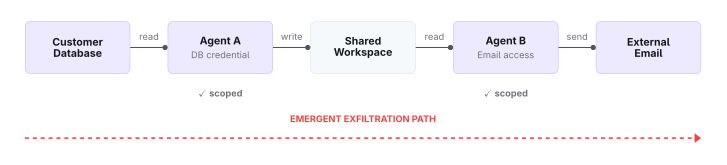
Locally authorised does not imply globally authorised. The effective capability reachable through the composed system exceeds the authority of any individual component. No permission was violated. No policy was misconfigured. The drift emerged from the topology of interactions between components — from the structure of the system itself.
Authority drift is difficult to detect through traditional access control because those mechanisms evaluate permissions locally. They verify that each component holds the credentials required for its immediate operation. They do not evaluate the consequences of composed actions across a system. A permission model that sees only individual grants cannot detect emergent paths through shared state.
Autonomous AI systems amplify authority drift because they dynamically generate action sequences rather than executing predetermined workflows. In traditional automation, the paths through a system are designed in advance and can be reviewed at design time. In autonomous AI systems, the paths are created at runtime — by reasoning processes that compose actions in response to context, goals, and environmental conditions that change from one moment to the next. The authority paths that matter most are the ones no designer anticipated.
The shared context that carries authority between components is also the dominant injection surface, and it is worth stating precisely what execution governance does and does not do about it. Prompt injection and indirect context poisoning — adversarial content placed in the data a component reads, inducing it to propose an attacker-chosen action — are the most prevalent real-world autonomous-agent bypass, and in modern deployments the “shared context” spans not just an in-memory workspace but persistent agent memory, vector stores, and message queues, widening the surface accordingly. Execution governance does not prevent a component being induced to propose such an action; it cannot tell a poisoned proposal from an honest one by inspecting the reasoning. What it does is govern the action at the boundary regardless of why it was proposed: a poisoned proposal that exceeds the presented authority is denied on exactly the same basis as a buggy or a malicious one. This is the source-independent invariant doing its work — it bounds the blast radius of a compromised reasoning plane to whatever the delegation in force authorises, which is precisely why the architecture validates the action rather than trying to validate the intent behind it. The corollary is load-bearing: governance is only ever as tight as the delegation, so an over-broad delegation re-opens the gap, and scope-narrowing is the real control.
The Authority Composition Principle, in its corollary, is a negative claim — a statement of what per-component access control cannot do. Its positive counterpart is the constitutional response in Clause 11 (Composition Closure) of the Governance Constitution, which defines what a governed composition must provide. Three conditions must hold simultaneously, each closing a specific failure mode.
First, every component must produce its own Evidence Record — a structured, tamper-evident record of each authorisation decision — at the action boundary. Without per-component evidence, the composition has no auditable record of authority.
Second, the delegation chain that admits cross-component action must be verifiable end-to-end and must narrow monotonically with each hop, never widen. A chain that cannot be validated, or that widens at any hop, is not governance — it is escalation.
Third, the coordination artefact through which one component conveys authority to the next (the message, event, or shared-state record) must declare an explicit schema identified by a cryptographic content hash, so that policies pattern-match against a stable shape rather than an implicit one. Without a stable schema identity, policies silently misalign as component composition changes.
The Composition Principle should not be read as a demand to compute the whole closure at runtime. The closure is the static authority graph — the set of paths reachable in principle, fixed at deploy time — and an architecture does not enforce the invariant by materialising it, which would be intractable. It enforces the invariant along the dynamic, realised path, by per-hop complete mediation: at each hop the boundary check validates the current delegation chain against the action actually proposed. This is the load-bearing reason a synchronous in-path check can be mandatory without being a bottleneck. A single decision is a local, deterministic evaluation over a snapshotted input tuple — constant work plus a term linear in the depth of the delegation chain (each hop is one scope-containment test and one evidence-record validation), independent of how many agents exist or how much total throughput the fleet sustains. Aggregate cost therefore scales linearly with action volume and parallelises across actors; it is not a function of the size of the reachable graph. Two corollaries keep this honest. The boundary check is genuinely on the critical path of each consequential action — it is synchronous, and its latency is paid every time — which is the cost the complete-mediation property necessarily incurs; and determinism is what makes that cost tractable, because a pure evaluation over fixed inputs is cheap and, where the inputs repeat, cacheable. Verifying after the fact is bounded too: a length-k delegation chain is k containment tests, and walking the evidence chain for tamper-evidence is linear in its length (or logarithmic with a Merkle structure over checkpoints).
These three conditions are the mechanism-level definition of governed composition in Clause 11: they are the criterion, so the load-bearing content is the necessity argument above — one named failure mode per dropped condition (no auditable record, silent escalation, schema drift) — not a derived sufficiency theorem. Within a shared trust root they are jointly sufficient to make the composition’s delegation non-escalating and end-to-end auditable. They do not, on their own, make the aggregate effect of independently-authorised actions policy-conformant, and the distinction matters. A content hash binds the shape of a coordination artefact, not its truthfulness: a malicious component can emit a schema-valid, hash-stable, correctly-narrowed artefact that asserts false context and causes the next component to authorise wrongly. So the same provenance requirement returns at the composition level — policies must evaluate over the attested provenance of facts, not merely schema-valid shape. Two frontiers remain open and are named as such: composing evidence records across organisations with different trust roots (named in the clause itself), and the forgeable-content / cross-action decomposition case, in which a prohibited outcome is split into several individually in-scope actions across several correctly-narrowing hops. Both are inspectable gaps, not silent ones — the constitution requires the cross-trust-root gap to be disclosed rather than assumed away.
4. The Execution Boundary
Every consequential action passes through a boundary: the point at which an intention becomes an irreversible state change in an external system. A database transaction commits. An API request is accepted by the remote service. A message is transmitted. A payment is posted to a ledger. A workflow is triggered.
Before this boundary, the action is a proposal. It can be evaluated, modified, deferred, or denied. After this boundary, the action is a fact. It can be investigated, compensated, or explained — but it cannot be undone.
This boundary is not an architectural invention. It is a structural property of any system that produces consequences. Transactional systems have long recognised it as the commit boundary — the point where a proposed state change becomes durable and visible to other systems. Distributed systems engineers design around it. Database architects build integrity guarantees at it. Payment networks place authorisation before it.
Governance that operates before the execution boundary is control: it determines whether a proposed action should proceed. Governance that operates after the execution boundary is investigation: it determines whether a completed action was acceptable. Both have value, but only pre-execution governance can prevent unauthorised consequences.
For autonomous AI systems, the execution boundary is the point where governance can be decisive — where the authoritative, non-bypassable decision is made. It is where the system’s intent meets the world’s state. Earlier stages may legitimately pre-stage authority facts to reduce the cost of the boundary check; what they cannot do is substitute for it, because before the boundary the action is not yet in its final form, and after it the consequence has already occurred. Every governance architecture for autonomous action must make its authoritative decision at this boundary. In a composed runtime the boundary is realised at a specific interception layer — post-parse tool dispatch, client-side middleware, an egress proxy, or target-service admission — and the choice of layer affects coverage and bypassability; which layer is the right one is a question this paper defers to the companion white paper. “Fully formed” is meant operationally: the canonical, serialised action immediately prior to dispatch, with no field left to be resolved after the decision.
5. Completing the Autonomous Control Loop
Autonomous AI systems are often described as control loops: they observe their environment, generate decisions, and execute actions. This structure resembles the feedback loops used throughout distributed systems engineering — in routing controllers, orchestration schedulers, and autoscaling systems.
The field is not empty: agent runtimes already interpose checkpoints between proposal and execution — graph interrupts, tool-confirmation callbacks, consent and elicitation prompts that pause for a human. The claim here is not that nothing sits between decide and execute, but that what sits there does not amount to governance on the terms this paper sets out. Those checkpoints are not deterministic, are not independent of the reasoning system that raised the proposal, do not produce verifiable evidence, are not composition-aware, and — where they rely on a human approval — do not scale to autonomous throughput. The autonomous decision loop is therefore missing a governing step: an independent, deterministic, evidence-producing mechanism that determines whether each action is authorised under current policy and delegation, before it executes. The resulting loop is incomplete:
observe → decide → execute
For systems that produce external consequences, this structure is insufficient. The speed of autonomous action exceeds institutional review. The scale of production deployments exceeds human oversight. The composition of interacting systems creates authority paths that no individual permission anticipated. Governance cannot remain an external process invoked around the loop. It must become a step within the loop itself.
Execution governance completes the loop:
observe → decide → authorise → execute
The missing step is not validation in the abstract, but explicit authorisation under current policy and delegation. Every proposed action is evaluated at the execution boundary before it produces consequences. This is not a security checkpoint bolted onto the system. It is the completion of a control loop that is otherwise structurally incomplete.
6. The Execution Governance Invariant
The preceding sections establish a single architectural rule:
Execution Governance Invariant. A system capable of autonomous action must evaluate the authority of every consequential action deterministically at the execution boundary under current policy and valid delegation before the action executes, and must produce verifiable evidence of that evaluation.
Or, in its informal form: no consequential action executes without verified authority.
This is not a recommendation or a best practice. It is the minimum structural requirement for any system that must be simultaneously autonomous and governed.
Definition — Execution Governance. Execution governance is the property of a system in which every consequential action is authorised deterministically at the execution boundary under current policy and validated delegation, and the decision produces verifiable evidence.
Weaken any part of it — permit actions without evaluation, evaluate without current policy, omit evidence — and governance degrades from a verifiable system property to an unverifiable assertion.
The invariant as stated forbids executing the unauthorised, but a one-sided rule is silent on its most important degenerate case: the evaluator itself failing. That gap is exactly where ungoverned execution slips through, so the invariant carries an explicit fail-closed clause.
Fail-Closed Clause. ALLOW requires that every authorising precondition — policy, delegation, revocation status, evidence integrity, and the freshness of each — be positively verified as current at evaluation time. If any precondition cannot be so verified, for any reason — it is absent, stale, unverifiable, or the evaluator is unavailable — the action does not execute; the outcome is DENY or ESCALATE. Partial evaluation is not evaluation, and integrity takes precedence over availability.
This gives a conforming architecture two proof obligations of opposite sign. Soundness: no unauthorised action executes — the direction the fail-closed clause secures. Completeness is a stated posture rather than a guarantee: a conforming system either shows that authorised actions are not spuriously denied, or explicitly accepts conservative over-denial as the price of fail-closing. The two are not symmetric, and the paper does not claim they are.
Fail-closing is correct, but it is not free, and the cost must be debited rather than assumed away. A mandatory in-path authoriser is itself a new single point of failure: a high-value, forge-everything target, and a denial-of-service lever, since an adversary who disrupts the revocation or time dependencies the clause relies on can convert fail-closed from a safety property into a fleet-wide halt of privileged action. Two things keep the trade positive. First, the distinction between failure modes: an integrity-critical denial (refusing to ALLOW when authority cannot be verified) is the system working as designed, while a loss of availability-of-governance is a different failure, mitigated by caching freshness-bounded reads within a declared window and by hardening the resolution dependencies, not by degrading to ALLOW. Second, the concentration is itself an asset: one small, in-path, tamper-evident plane is more hardenable and more auditable than diffuse embedded controls, and because its decisions are evidenced, a compromise of the authoriser is converted into a detectable, replayable event rather than a silent one.
When software systems acquire the ability to act autonomously, governance becomes a runtime property of the system rather than an institutional process around it.
7. Principles of Execution Governance
The structural requirements established above define a set of principles that any governance architecture for autonomous AI systems must satisfy. These principles are not implementation prescriptions. They are conceptual invariants — properties that hold regardless of the specific technology, framework, or deployment model used to realise them.
1. Governance must precede consequence. Actions must be evaluated before they produce state changes in external systems. Post-hoc audit cannot govern autonomous execution. It can only investigate it. The governance decision must occur at the execution boundary — after the action is fully formed but before it takes effect.
2. Authority must be explicit. The authority under which an autonomous AI system acts must be represented explicitly and verified at the time of action — not inferred from identity, role, or institutional trust. Implicit authority creates confused deputies: systems that act with permissions they were not intentionally granted for the operation at hand. Explicit authority means the system can answer, for every action: which authority authorised this, under what scope, with what constraints, and is that authorisation still valid?
3. Evaluation must be deterministic over an explicit, frozen input set. Determinism is not “the same outcome regardless of time”; it is “the same outcome for the same inputs,” and the inputs must be named. The governance decision is a pure function d = G(action, authority/delegation, policy_version, revocation_state, context_snapshot, time_source) of a tuple snapshotted at the execution boundary and held fixed for the duration of one evaluation. This dissolves the apparent tension between “current policy” (time-varying) and “same outcome every time” (time-invariant): the time-varying state — policy version, revocation epoch, the asserted time — enters as explicit, versioned members of the frozen tuple, so identical tuples always yield identical decisions while a change in any member is a change in the inputs, not a breach of determinism. Determinism is necessary but not sufficient: the evidence record must capture and bind the exact input tuple (policy hash, delegation state with its revocation epoch, freshness and clock source), so that replay re-derives both the output and the provenance of the inputs it was computed from. Determinism transforms governance from an assertion (“we have policies”) into a verifiable property (“given these exact inputs, this was the only possible decision”); without it, governance decisions cannot be independently replayed or verified.
4. Governance must be decisive at the execution boundary. The point at which governance can be decisive — where the authoritative, non-bypassable decision is rendered — is the moment immediately before an action produces consequences. Governance that operates earlier (at the planning stage) cannot account for the final form of the action; it can pre-stage authority facts to make the boundary check cheaper, but it cannot stand in for it. Governance that operates later (at the audit stage) cannot prevent the consequence. The execution boundary is where intent meets the world — and where the authoritative decision must be made.
5. Every decision must produce evidence. Authorisation decisions must produce durable, tamper-evident records that prove governance occurred. The evidence must bind together the action that was proposed, the authority under which it was evaluated, the policy that was applied, and the decision that resulted. Without evidence, governance is an unverifiable claim. With evidence, governance becomes an auditable system property.
6. Governance must be independent of the governed system, and on the only path to consequence. This principle has two parts, and the second is the one that makes the first load-bearing.
Verdict independence. The system that generates an action proposal must not be the system that authorises it. The governance mechanism must be outside the decision path of the system whose actions it evaluates. A system that governs its own actions is a system without external accountability. This independence is structural, not organisational — the verdict cannot be influenced or degraded by the reasoning system it governs, and in particular the denial of an action does not depend on that system’s cooperation.
Complete mediation (interposition). Independence alone is insufficient: an independent but optional governor is simply skipped by an agent that holds a live credential or an open socket. The governor must therefore sit on the only path from intent to consequence. The agent must hold no direct capability to the external world — it cannot itself open the socket, present the credential, or call the API — so that “not invoking the governor” is identical to “not performing the action.” This is the complete-mediation principle of Saltzer and Schroeder (1975), applied at the execution boundary: every consequence-producing access is checked, with no unchecked path around the check. The threat model this requires is explicit: a hijacked, buggy, or malicious driver must be unable to reach the world except through the governor. Interposition is typically realised by brokering the actor’s credentials or by mediating its egress, so that the capability to act is held by the governance plane and lent to the action only after authorisation. Without this property the entire architecture is an advisory checker that a compromised driver bypasses; with it, the source-independent invariant has the mechanism that makes it true rather than asserted.
7. Governance must compose across systems. Authority evaluation must remain valid across multi-system environments where autonomous AI systems interact, delegate to each other, and share context. Governance that applies only within a single system boundary cannot address the emergent authority paths that arise when systems compose. The governance architecture must account for delegation chains, scope narrowing, and cross-system authority propagation.
8. The authorised artefact must be the executed artefact. “Before the action executes” presumes that the artefact evaluated and the artefact executed are bit-identical, and that nothing changes between the two. The canonical action authorised at the boundary must be content-addressed — hashed at evaluation time — and execution must refuse any payload whose hash differs from the authorised one. Without this binding, a time-of-check/time-of-use gap re-opens the boundary: in the composition example above, the outbound send reads its content “from shared context,” a read that can occur after authorisation, so the decision can pass while the consequence diverges from what was decided. The binding must extend to the policy side as well. The authorise-then-execute step is a critical section: it must be atomic with respect to policy and delegation changes — a revocation that lands between check and use must not be raced by the commit — and with respect to concurrent actions that share the same authority, under a defined serialisation order, so that two actions individually authorised do not jointly cross a threshold neither was permitted to cross alone. Two further properties follow at this boundary. An authorisation must be single-use against replay: a nonce or monotonic action identifier is bound into the canonical action and the evidence record, so that a captured-but-unrevoked delegation or a re-injected ALLOW cannot re-execute a consequential action. And replayability-for-audit must be distinguished from replay-resistance-of-execution: the decision is a pure, replayable function for verification, which is a different property from preventing a real ALLOW from being executed twice — the binding and the nonce supply the latter, the pure function does not.
8. Historical Lineage
The governance challenges of autonomous AI systems are not unprecedented. Computer security research has long recognised the dangers of implicit authority and the structural requirements of mediated access.
Early work on the confused deputy problem (Hardy, 1988) showed how software could misuse privileges granted for one purpose when acting on behalf of another — revealing the fundamental instability of ambient authority. Capability-based security (Dennis & Van Horn, 1966) responded by making authority explicit and transferable: a program could act only with the permissions it had been explicitly granted. Saltzer and Schroeder (1975) formalised the design principles that any protection mechanism must satisfy, including complete mediation — the requirement that every access be checked. Lampson (1974) demonstrated that authority emerges from the structure of relationships between subjects and objects, and that as systems grow complex, unintended authority paths arise from composition.
Modern distributed systems revived these principles under new names: identity systems, policy decision points, and control planes. Autonomous AI systems bring these historical threads together. They generate actions autonomously, propagate authority dynamically, and execute across distributed infrastructure. Authority drift is the systems-level consequence of ambient authority under composition. The governance challenges autonomous AI systems create — confused deputies at scale, authority drift through composition, the need for complete mediation at the execution boundary — are not novel problems. They are the convergence of problems that computer security identified decades ago, now amplified by systems that act without human intervention.
The architecture of execution governance — and its relationship to the confused deputy lineage, capability systems, and distributed control planes — is examined in the companion white paper, From Confused Deputies to Execution Governance. The infrastructure implications — why this governance layer follows the same convergence trajectory as identity, networking, and payment infrastructure — are explored in The Ambit Infrastructure Thesis.
9. Conclusion
Autonomous AI systems transform governance from an institutional process around software into a runtime property of software itself. Once systems produce consequences rather than outputs, governance must operate at the execution boundary — before consequence occurs — and must produce verifiable evidence that it did so.
That requirement is captured by the execution governance invariant. Deterministic governance guarantees replayability of the decision, not correctness of the policy being applied — but without determinism, neither replayability nor correctness is verifiable. The principles that follow from the invariant define what any governance architecture for autonomous AI systems must satisfy. The architectural form of that governance is examined in the companion white paper. The infrastructure implications are explored in the thesis.
The guarantee has an outer edge, and naming it is what keeps the positive claims falsifiable rather than rhetorical.
What execution governance does not guarantee. It does not validate that the policy is correct — a sound evaluation of an unsound policy is faithfully wrong. It does not prevent harm from a correctly-authorised action; policy-conformant-but-harmful is out of scope, a matter for the policy, not the evaluator. It does not detect a compromised-but-valid principal acting within its delegation, nor prevent a reasoning plane being induced to propose a hostile in-scope action — it contains the blast radius to whatever the delegation authorises, it does not stop the proposal. Intent fidelity is a property of how tightly the delegation is scoped, not a property the evaluator supplies. And cross-trust-root composition remains an open frontier. Each of these is an inspectable policy or architecture gap, not a failure of the framework — but the framework does not close them, and does not claim to.
The governance of autonomous action is not a product category. It is a structural property of computing systems in which software possesses the ability to act. As autonomous AI systems become integrated into financial systems, infrastructure control planes, and distributed services, the requirement for execution governance will follow the same trajectory as identity, networking, and payment authorisation: from application-specific mechanisms to shared infrastructure.
The principles defined here do not depend on any particular implementation. They follow from the structure of autonomous action itself. Any system that allows software to produce external consequences must eventually satisfy them.
References
Denning, D.E. (1976). “A Lattice Model of Secure Information Flow.” Communications of the ACM, 19(5), 236–243.
Dennis, J.B. & Van Horn, E.C. (1966). “Programming Semantics for Multiprogrammed Computations.” Communications of the ACM, 9(3), 143–155.
Hardy, N. (1988). “The Confused Deputy: (or why capabilities might have been invented).” ACM SIGOPS Operating Systems Review, 22(4), 36–38.
Lampson, B.W. (1974). “Protection.” ACM SIGOPS Operating Systems Review, 8(1), 18–24.
Myers, A.C. & Liskov, B. (1997). “A Decentralized Model for Information Flow Control.” Proceedings of the 16th ACM Symposium on Operating Systems Principles (SOSP ‘97), 129–142.
Saltzer, J.H. & Schroeder, M.D. (1975). “The Protection of Information in Computer Systems.” Proceedings of the IEEE, 63(9), 1278–1308.