

The Ambit Infrastructure Thesis
Governance of Autonomous AI Action: Why the Authorisation Layer Becomes Inevitable
Abstract. Autonomous AI systems generate actions through probabilistic reasoning. Organisations must answer two questions about every consequential action: was it authorised according to policy, and can they prove it? This document argues that an independent authorisation layer is not merely useful but structurally inevitable. The argument proceeds from the autonomy–control contradiction, through the architectural resolution into three separated planes, the six enforcement planes and one non-authoritative control surface, and the evidence architecture — to the historical trajectory that makes this layer as inevitable as identity infrastructure, network control planes, and payment authorisation networks.
Research programme. The Governance of Autonomous Action establishes the conceptual foundations of execution governance. From Confused Deputies to Execution Governance develops the architecture. This paper examines why this governance layer becomes infrastructure.
1. Autonomous AI Systems and the Governance Gap
Autonomous AI systems generate actions through probabilistic reasoning. Unlike traditional software, which executes deterministic instructions written by developers, these systems reason over information, select their own actions, and produce tool invocations, API calls, database modifications, and infrastructure operations dynamically. The action space is open-ended. A model does not follow a fixed control flow; it proposes actions based on statistical inference, contextual reasoning, and delegated goals. The same system, given similar inputs, may produce different sequences of operations.
This flexibility is precisely what makes autonomous AI systems valuable. It is also what makes them ungovernable under existing architectures. Autonomous systems scale capability through probabilistic reasoning; they scale trust through deterministic governance. Today, the capability is scaling. The governance is not.
Organisations deploying autonomous AI systems must answer two questions about every consequential action those systems perform. First: was the action authorised according to policy? Second: can the organisation prove that authorisation occurred? These are not aspirational questions. They are the questions that auditors, regulators, and incident investigators will ask — and that today’s control architectures cannot answer.
The gap is not a shortage of controls. Enterprises deploy six mature categories of security and governance tooling, each addressing a real concern:
| Control Family | Boundary | What It Can Prove | What It Cannot Prove |
|---|---|---|---|
| Identity and Access Management | Identity / resource | Who holds permission to access a resource | Whether a specific autonomous action was authorised under a specific delegation |
| Policy Engines | Request / rule | That a request matched declarative rules | That the delegation chain was valid, temporally fresh, and unrevoked |
| Guardrails and Content Filtering | Model output | That model output was constrained | That the resulting tool invocation was authorised at the execution boundary |
| Framework-Scoped Controls | Application lifecycle | That developer-defined workflows were followed | Whether execution authority can be independently verified across frameworks |
| Logging and Observability | Post-execution | What occurred and when | Whether the action should have been allowed before it executed |
| Network Security | Connection / perimeter | That connections were permitted | That the data flowing through permitted connections was authorised to flow |
The gap is not in any single row. It is that no combination of rows produces a pre-execution record binding the action, the delegation, the policy, and the decision into independently verifiable evidence. Each control operates at a different boundary, addresses a different concern, and produces a different kind of assurance. None composes with the others into a synchronous, pre-execution governance gate that evaluates the specific action, verifies the delegation chain, renders an explicit decision, and produces tamper-evident evidence — all before the action executes.
The consequences of this gap are not theoretical. The architecture that follows is designed against a specific threat model — five categories of governance failure that existing controls cannot address:
- Reasoning error — the model proposes an unsafe or policy-violating action through faulty inference.
- Capability escalation — delegated authority is widened, stale, or unverifiable, permitting actions beyond intended scope.
- Policy drift — governance rules change without replayable traceability, making historical decisions unverifiable.
- Execution ambiguity — no pre-execution record establishes which authority enabled an action.
- Evidence tampering or gaps — logs are absent, incomplete, or altered, making governance unverifiable after the fact.
Each category is addressed by a different aspect of the architecture.
The argument that follows is that an independent authorisation layer is not merely useful but structurally inevitable. It proceeds in thirteen steps: from the core contradiction that autonomous AI systems create (Section 2), through the architectural resolution (Sections 3–7), the enforcement surfaces that governance must cover (Section 8), the evidence architecture that makes governance verifiable (Sections 9–10), the structural requirement for independence (Section 11), the historical trajectory that makes this layer inevitable (Section 12), the control-plane pattern that names it (Section 13), to the destination (Section 14).
The architectural details of this layer are developed in the companion research white paper; this document addresses a different question: why such a layer becomes structurally inevitable.
The framing throughout is architectural, not commercial. The question is not whether a particular product succeeds but whether the governance of autonomous AI action converges on an independent, evidence-producing, vendor-neutral layer — the same structural convergence that produced identity infrastructure, network control planes, container orchestration, and payment networks. The evidence suggests it must.
2. The Autonomy–Control Contradiction
The failure of existing control families to compose into governance is not accidental. It reflects a structural contradiction inherent in any system that must be simultaneously autonomous and governed.
The system must be autonomous to be useful. The value of autonomous AI systems lies in their capacity to reason over complex domains, discover novel strategies, adapt to changing contexts, and automate tasks that resist deterministic specification. Restricting the reasoning process — constraining which thoughts the system may have, which tool sequences it may consider, which strategies it may explore — destroys the capability that justifies deployment. An autonomous AI system that can only follow predetermined paths is a workflow engine with higher compute costs.
The system must be governed to be trustworthy. Actions that modify infrastructure, initiate financial transactions, transmit sensitive data, or alter persistent records must be authorised according to policy. Without governance, every action is implicitly permitted — including actions that violate regulations, exceed delegation scope, or produce irreversible harm. An autonomous AI system that can take any action without constraint is not an employee; it is an unaccountable principal with the keys to the building.
Traditional approaches resolve this contradiction by sacrificing one side. Systems that prioritise autonomy provide weak governance guarantees: the model reasons freely, but no mechanism ensures that the resulting actions are authorised. Systems that prioritise control restrict the reasoning process itself: guardrails constrain outputs, prompt engineering limits action selection, and hardcoded allowlists reduce the system to a narrow set of pre-approved operations. The first approach loses governance. The second loses capability. Neither is acceptable.
The Theory of Inventive Problem Solving (TRIZ; Altshuller, 1999) provides a precise vocabulary for this situation. The autonomy–control conflict is a technical contradiction: improving one parameter (reasoning autonomy) worsens another (action controllability). TRIZ further identifies a physical contradiction at the action level: the action selection process must be simultaneously probabilistic (to enable creative reasoning) and deterministic (to enable governance). A single mechanism cannot be both.
TRIZ resolves physical contradictions through separation. The resolution principle is: do not constrain reasoning; govern consequence. Separate the system into components that handle each requirement independently. Let the probabilistic process do what it does best — reason, plan, propose. Let a deterministic process do what it does best — evaluate, decide, record. The contradiction dissolves when governance operates on a different plane from reasoning.
This is not a design preference. It is the only resolution that preserves both properties.
Any architecture that constrains reasoning to achieve governance has collapsed the contradiction into a single mechanism — and must sacrifice one side to serve the other. Any architecture that separates reasoning from governance can serve both. There is no third option.
The separation principle is easy to state and difficult to implement. It demands answers to precise architectural questions. Where does governance occur? What does it evaluate? What guarantees does it provide? The remaining sections answer those questions. But the structural point must be established first: the autonomy–control contradiction is inherent in autonomous AI systems, it cannot be resolved by better engineering within a single plane, and it dissolves only when reasoning and governance are architecturally separated.
3. Why Guardrails Cannot Solve the Problem
The most common objection to the inevitability argument is that better guardrails will suffice. If guardrails are improved — made more sophisticated, more context-aware, more comprehensive — they will eventually close the governance gap. This objection deserves a serious answer, because guardrails are genuinely useful and the argument against them is not that they fail but that they govern the wrong surface.
Guardrails are necessary. They reduce harmful outputs, enforce content policies, catch prompt injection attempts, and constrain model behaviour within acceptable bounds. Any serious deployment of autonomous AI systems should include them. The argument that follows is not against guardrails. It is against the belief that guardrails are sufficient — that improving them enough will eventually close the governance gap. That belief is architecturally mistaken.
Guardrails operate at the language boundary. They evaluate what the model says — the text it produces as output. A guardrail can determine whether a model’s response contains prohibited content, whether the output conforms to structural requirements, and whether the generated text matches or violates predefined patterns. This addresses a real category of risk: the risk that a model produces harmful, misleading, or policy-violating text.
But text production and action execution are different operations at different boundaries. A model may produce acceptable text while proposing an action that violates policy. The model’s output might say “I’ll help you process that refund” — text that passes every guardrail — while the tool invocation it generates issues a refund that exceeds the delegation scope, violates temporal constraints, and lacks the required approval. The guardrail evaluated the language. Nobody evaluated the action.
This is the crux: once reasoning produces a tool invocation, the guardrail is no longer in the control path. The tool call flows to the execution layer with whatever parameters the model selected. The guardrail cannot see the tool call’s parameters, cannot evaluate whether the delegation chain authorises this specific invocation, cannot check whether the target resource falls within the permitted scope, and cannot produce evidence that governance occurred. The guardrail’s jurisdiction ends where consequence begins.
Better guardrails do not change this architecture. More accurate classifiers, more comprehensive pattern matching, more sophisticated semantic analysis — all improve the quality of language-boundary evaluation. None extends the evaluation to the action boundary. A perfect guardrail that catches every harmful output with zero false positives still does not evaluate tool invocations, verify delegation chains, or produce pre-execution evidence records.
Perfection at the wrong boundary does not compensate for absence at the right one.
The distinction is categorical, not incremental.
Guardrails govern what a model may say. Governance governs what a system may do.
These are different surfaces operating at different boundaries on different representations. A guardrail evaluates a text string. An action-boundary evaluation evaluates a structured canonical representation: actor identity, intent, target resource, parameters, delegation context, policy identity, and evaluation timestamp. A guardrail produces a binary classification (pass or block) on the text. An action-boundary evaluation produces an explicit decision (ALLOW, DENY, or ESCALATE) on the action, with a full reason trace and tamper-evident evidence. A guardrail’s output disappears after the text is released. An action-boundary evaluation’s receipt persists as independently verifiable proof that governance occurred.
Guardrails and governance are complementary, not competing. Guardrails govern the model boundary — a non-authoritative control surface described in Section 8, distinct from the six enforcement planes. Governance governs the action boundary. A well-architected system deploys both. But the governance gap exists at the action boundary, and no amount of improvement at the language boundary closes it.
4. The Moment of Consequence
If guardrails govern the wrong boundary, where is the right one?
The answer is architectural, not operational. Governance must occur at the boundary where intent becomes consequence — the point where a proposed action would produce a real-world effect. This is the action boundary: the moment at which a tool invocation, API call, database write, or infrastructure modification transitions from being a proposal inside a reasoning system to being an operation that changes something outside it. Before that moment, the action is an intention. After it, the action is a consequence. Governance must stand at the threshold.
The action boundary is downstream of reasoning, upstream of execution, and independent of any specific vendor, framework, or runtime. It exists wherever autonomous AI systems interact with external systems. An MCP tool call crosses the action boundary. An HTTP request to an external API crosses the action boundary. A write to a vector store crosses the action boundary. Each crossing is a moment where governance can either evaluate the proposed action or permit it to proceed unevaluated. There is no third option.
The temporal distinction matters. A governance record produced before execution is a fundamentally different artefact from a log entry produced after it. Pre-execution evaluation renders a decision — ALLOW, DENY, or ESCALATE — and that decision determines whether the action proceeds. The evidence record produced at that moment binds the decision to the policy, the delegation, and the action before any consequence occurs. Post-execution logging records what happened but cannot change it. The action has already executed. The database row has already been modified. The money has already moved. The data has already been transmitted.
The distinction is epistemic, not merely temporal. Proving that something happened is not the same as proving it was permitted. A log reconstructs history. An evidence record establishes legitimacy. One tells you that a refund was issued at 14:32. The other tells you that the refund was evaluated against policy version 7a3f..., under delegation d-2847 with scope narrowed to refund.issue actions below $500, and the decision was ALLOW based on rule amount_within_scope — and here is the cryptographic proof. The difference is the difference between a surveillance camera and a signed warrant. Both record events. Only one establishes authority.
The moment of consequence is not a product feature. It is the only architecturally correct location for governance of autonomous AI action. Any system that evaluates actions before this boundary is evaluating intentions, not operations — and intentions can change between evaluation and execution. Any system that evaluates actions after this boundary is monitoring, not governing — and monitoring cannot prevent the consequence it observes. Only evaluation at the action boundary, synchronously, before execution proceeds, satisfies both requirements: the action is assessed in its final form, and the assessment determines whether it executes.
This is the architectural foundation on which everything that follows is built. The three-plane architecture (Section 5) positions governance at this boundary. The deterministic evaluation function (Section 6) defines what happens there. The evidence chain (Section 10) records what happened.
The foundational claim is simpler: governance must stand at the moment of consequence, or it is not governance.
5. Execution Governance: The Three-Plane Architecture
The autonomy–control contradiction dissolves when the system separates into three planes, each responsible for exactly one concern.
The reasoning plane is probabilistic. It includes language models, planning systems, orchestration frameworks, and any mechanism that proposes actions based on contextual reasoning. The reasoning plane generates candidate actions — tool invocations, API calls, data operations — through whatever inferential process the model employs. Governance does not constrain this plane. The model may reason about anything, consider any strategy, and propose any action. The reasoning plane’s output is not a consequence; it is a proposal.
The authorisation plane is deterministic. It receives the proposed action as a structured canonical representation and evaluates it against compiled policy, validated delegation artefacts, and the current governance configuration. The evaluation function is pure: it takes defined inputs and produces exactly one of three outcomes — ALLOW, DENY, or ESCALATE. Silence is DENY. There is no implicit approval, no probability score, no “log and allow.” Every evaluation produces a tamper-evident evidence record binding the decision to the inputs that produced it.
The execution plane is consequence-producing. It carries out the authorised action: calling the API, writing to the database, modifying the file, transmitting the data. Execution occurs if and only if the authorisation plane renders ALLOW. The execution plane does not evaluate policy. The authorisation plane does not execute actions. The reasoning plane does neither.
This is the same architectural separation that networking introduced between control planes and data planes: the component that decides is independent of the component that executes. Section 13 develops this analogy in full.
The system flow is linear: propose → evaluate → decide → execute (if ALLOW) → receipt.
The architecture crystallises into a single invariant:
Execution Governance Invariant. No action that produces external consequences may execute unless its authorisation has been deterministically evaluated against the canonical action, the delegation artefacts, and the policy identity at the action boundary — and unless that evaluation has produced a tamper-evident evidence record before execution proceeds.
An autonomous AI system proposes a write action targeting a customer database record, with parameters specifying the fields to modify. The proposal is intercepted at the action boundary and transformed into a canonical action representation: actor identity (the system operating under delegation d-4819), intent (write), target (customer_db/records/8472), parameters (the field modifications), delegation context (scope limited to write actions on customer_db, valid until 2026-03-15T00:00:00Z, revocation status verified fresh within the last 60 seconds), and policy identity (compiled policy hash c9e2...). The authorisation plane evaluates this canonical representation. If the delegation is valid, the scope includes the target, the temporal constraints are satisfied, and no deny rule matches, the decision is ALLOW. The evidence record is produced. The execution plane proceeds. If any condition fails — delegation expired, target outside scope, deny rule matched — the decision is DENY or ESCALATE. The evidence record is produced. Execution does not proceed.
Why three planes, not two? Because the authorisation plane must not collapse into either of its neighbours. If authorisation collapses into reasoning — if the model itself decides whether its actions are permitted — then governance inherits the probabilistic, non-deterministic properties of the reasoning process. The same action might be permitted or denied depending on the model’s inference path. Governance becomes subjective. If authorisation collapses into execution — if the execution layer retroactively determines whether the action should have been allowed — then governance occurs after consequence. The action has already executed. Evidence is reconstructed, not produced.
The separation is not an engineering convenience. It is a constitutional invariant. The Governance Constitution’s Separation of Planes clause (Clause 8) requires that governance remain structurally distinct from adjacent systems. The test for separation is behavioural: a change to any adjacent system — model version, framework, runtime — must not alter governance evaluation semantics unless a corresponding, explicit change is made to governance configuration. If upgrading a model changes what is allowed or denied without a policy change, the planes are not separated.
The canonical action representation flows through the planes unchanged. It carries:
- Actor identity: who is acting (the autonomous AI system under a specific delegation)
- Intent: the operation requested (read, write, send, delete, execute, delegate)
- Target: the resource affected (identified by domain, path, classification)
- Parameters: the operation specifics
- Delegation context: the authority under which the actor operates (scope, temporal bounds, revocation status)
- Policy identity: the compiled policy against which evaluation occurs (content hash)
- Evaluation timestamp: when the evaluation was rendered (from a cryptographically authenticated time authority)
This representation is the interface between planes. The reasoning plane produces it. The authorisation plane evaluates it. The evidence record preserves it. The same canonical vocabulary operates regardless of which model, framework, or runtime produced the proposal — which is what makes the architecture vendor-neutral rather than vendor-specific.
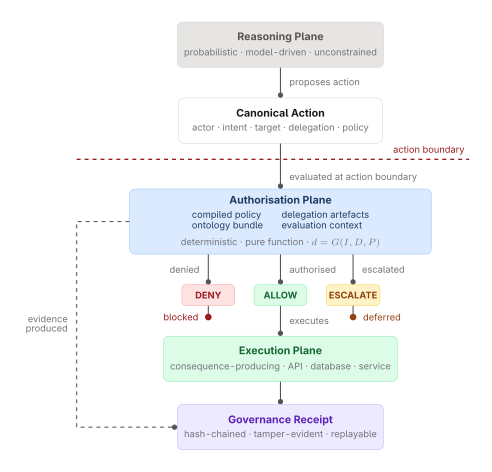
The architecture extends naturally to multi-system environments. When multiple autonomous AI systems coordinate — through delegation chains, shared workspaces, event triggers, or composition — each system’s proposed actions cross the action boundary independently. The authorisation plane evaluates each action on its own terms: its own actor identity, its own delegation context, its own target. Coordination complexity lives in the reasoning and execution planes. The authorisation plane sees only canonical actions and renders only deterministic decisions. This is what makes the architecture scalable: the authorisation plane’s complexity does not grow with the coordination complexity of the systems it governs.
The three-plane model resolves the autonomy–control contradiction. Each plane does one thing. No plane interferes with the others. The contradiction is not managed — it is dissolved.
6. Deterministic Authority
The authorisation plane’s central property is determinism. The evaluation function must produce identical decisions for identical inputs — always, everywhere, under any runtime conditions. This is not a design preference. It is the property that makes governance auditable, reproducible, and independently verifiable. Without it, governance becomes subjective: two evaluations of the same action under the same policy might disagree, and no external party could determine which was correct.
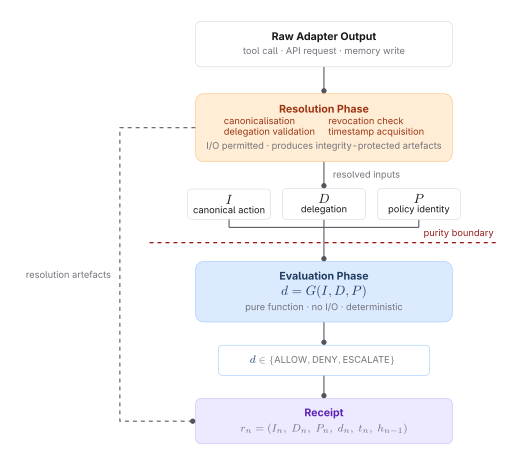
The entire governance model reduces to a single formal statement. Let denote the canonical action, the validated delegation artefacts, and the policy identity. The governance function is the pure function:
where . Execution is permitted only when .
In operational terms: decision = Authorise(canonical_action, validated_delegation, policy_bundle) — where canonical_action is the structured representation of the proposed operation (actor, intent, target, parameters), validated_delegation carries the scoped, time-bound, revocation-checked authority under which the system acts, and policy_bundle is the content-addressed compilation of governance rules and ontology against which the action is evaluated.
Every evaluation produces a receipt:
where is the evaluation timestamp acquired during resolution (a resolved input artefact, not a runtime-generated value), and is the previous receipt hash, forming the tamper-evident chain described in Section 10.
The purity requirement is absolute. The evaluation function performs no I/O. It reads no external state. It makes no network calls. It consults no databases. Given the same canonical action, the same delegation artefacts, and the same policy identity, it produces the same decision — on any hardware, at any time, under any operational conditions. Two independent evaluators, provided with identical inputs, must produce byte-identical receipts.
This purity is achievable only because of a deliberate architectural separation between resolution and evaluation.
Resolution is the phase that assembles the evaluation’s inputs. It is permitted to perform I/O. Canonicalisation transforms raw adapter output into the canonical action representation. Revocation checks consult external services to determine whether the delegation has been revoked. Timestamp acquisition obtains a cryptographically authenticated time assertion. Delegation validation verifies temporal bounds, scope constraints, and chain integrity. These steps produce integrity-protected artefacts — the canonical action, the materialised delegation state, the verified timestamp — that become the evaluation function’s inputs. Resolution may fail. If it fails, the action is denied: the canonical input is incomplete, and evaluation cannot proceed.
Evaluation is the phase that renders the decision. It consumes the resolved inputs and nothing else. It is a pure function. It cannot fail due to external factors — all external dependencies were resolved in the previous phase. This separation is what makes determinism achievable: the evaluation function has no external dependencies because all external dependencies were resolved before evaluation began.
The fail-closed semantics are comprehensive. An unknown action type is denied. A missing delegation for a privileged action is denied. An expired delegation is denied. A delegation whose revocation status cannot be verified within the required freshness window is denied. An evaluation that cannot complete — because the policy is unparseable, the ontology bundle is missing, or any input assembly step fails — is denied. There is no fallback policy. There is no degraded mode. Integrity takes precedence over availability. A system that silently degrades governance to maintain throughput is not governed; it is merely optimistic.
Policy itself is data, not code. Tool classifications (safe, privileged, destructive), temporal constraints, delegation requirements, and approval thresholds are declared in a compiled policy configuration identified by its content hash. The ontology bundle — the domain model that defines the canonical vocabulary, field semantics, and valid enumeration values — is similarly identified by a content hash. Together, the policy hash and ontology hash form a complete, immutable reference to the rule system under which any decision was made. Policy changes produce new hashes. Decision records bind to specific hashes. An auditor examining a historical decision can load the exact policy and ontology versions that were in effect and replay the evaluation to confirm correctness.
Determinism is not a technical nicety. It is the property that transforms governance from an operational assertion (“we have policies”) into a mathematical guarantee (“given these inputs, this was the only possible decision, and here is the proof”). Without determinism, governance is a claim. With determinism — and with the evidence chain that determinism makes possible — governance is a verifiable system property.
7. Delegation and Capability Semantics
The autonomy–control contradiction is resolved architecturally by separating reasoning from governance. But separation alone does not answer a deeper question: under what authority does an autonomous AI system act?
Traditional systems answer this question with identity. A user authenticates, permissions are looked up, and access is granted or denied based on role membership. This works when the entity requesting access is the principal whose intent the action represents.
Autonomous AI systems break this assumption. The system is not the principal. It acts on behalf of a principal — a human operator, a service account, an upstream system — under authority that was explicitly granted to it. It exercises delegated authority. And that delegation must be explicit, scoped, time-bound, revocable, and verifiable at the moment of action.
The Governance Constitution (Clause 4) is unambiguous: “Agents do not possess inherent authority. If an agent can act, it acts under authority that was explicitly delegated to it.” Authority inferred from identity, role labels, or ambient runtime context is not sufficient. If authority cannot be traced to a presented, validated delegation artefact, the action is denied.
A delegation artefact is a structured claim carrying:
- Scope: the actions, tools, paths, and domains the delegation permits.
scope.actionsenumerates permitted canonical action types.scope.toolsenumerates permitted tool identifiers.scope.pathsconstrains filesystem-like target prefixes.scope.domainsconstrains resource domains. - Temporal bounds:
nbf(not-before) andexp(expiry) timestamps defining the window during which the delegation is valid. The authorisation plane rejects delegations where the current time falls outside this window. - Revocation status: whether the delegation has been explicitly revoked. Revocation status must be cryptographically verifiable and include freshness bounds. If revocation information is absent, freshness bounds are not declared, revocation status is unverifiable, or the declared validity window has been exceeded — the action is denied.
- Kind: the mechanism conveying the delegation (JWT, API key, session, OAuth), versioned for structural validation.
The scope narrowing invariant is fundamental: a child delegation’s scope must be a subset of its parent’s scope. Delegation chains must be end-to-end traceable. Sub-delegation must preserve or narrow the delegator’s authority scope and must never widen it. Bounded delegation chain depth prevents unbounded transitive authority. If the chain cannot be validated end-to-end, the action is denied.
This authority model has a fifty-year lineage in systems security. Saltzer and Schroeder (1975) established the foundational design principles — least privilege, complete mediation, fail-safe defaults — that the architecture applies to autonomous AI action. The lineage matters, because the same structural problem has been solved before.
The core question is where authority lives. In the access-control list tradition, authority lives at the resource: a file carries a list of permitted identities. Delegation is administrative — modify the list. Revocation is easy (remove the entry), but authority cannot travel with the actor. In the capability tradition (Dennis and Van Horn, 1966; KeyKOS, EROS, seL4, Miller’s object-capability work), authority lives with the actor as an unforgeable token that both designates a resource and conveys the right to operate on it. Delegation is natural — pass the token, pass the right. But revocation is hard: the token is a bearer credential, and revoking it means finding every copy. The revocation problem prevented capability systems from reaching mainstream deployment.
Autonomous AI systems break the ACL model’s assumptions. Authority must travel with the system — through every tool invocation, every sub-delegation, every boundary crossing — because the system accesses resources dynamically across trust boundaries no single administrator controls. The structural conditions that capability security was designed to handle have returned.
The governance architecture resolves the historical trade-off by changing when authority is verified. Delegation artefacts travel like capabilities — carried with the actor, scoped to the context, presented at the boundary. But they are verified like access-control entries — checked against current state, at every action boundary. This recovers revocation control (check status at every evaluation, deny if stale or unverifiable) without sacrificing delegation fluency (the artefact still travels with the actor).
Two properties extend beyond what either classical tradition provided. First, deterministic evaluation: the decision function is pure, its output reproducible by any party with the same inputs — a property that kernel-level capability checks, rendered opaquely, never offered. Second, cryptographic evidence: every evaluation produces a chained receipt that any third party can verify. Classical capability systems could enforce authority at the point of action, but could not prove to a third party that enforcement occurred correctly. The receipt closes that gap.
The confused deputy problem — Hardy (1988) — dissolves under this model. The confused deputy arises when authority is ambient: a program cannot distinguish its own authority from the caller’s. In the delegation model, authority is not ambient. It is carried, scoped, and presented. The authorisation plane evaluates the delegation, not the identity. A system with broad capabilities but a narrow delegation can only exercise the narrow delegation. Only the presented delegation matters.
The consequence for governance of autonomous AI action is direct: delegation semantics are not an optional feature of the authorisation layer. They are what transforms coarse-grained permission checks into action-level governance — the difference between “this system may access the database” and “this system, under this delegation, may write this field in this record, right now, and here is the proof.”
8. Enforcement Planes and Control Surfaces
The preceding sections established the architecture: three planes, deterministic evaluation, delegation semantics. But architecture describes the mechanism. The question now is: where must the mechanism be deployed? Section 1 identified six existing control categories and the governance concern that none provides. This section examines the enforcement planes and control surfaces within the governance architecture itself, each governing a distinct category of consequence-producing action.
A security team at a healthcare company deployed action-boundary governance at the tool boundary. Every tool invocation was evaluated against policy. Every evaluation produced a receipt. The team was confident. Then an internal audit discovered that one of their autonomous AI systems had been writing patient identifiers to a vector store — not through a governed tool call, but through the system’s built-in memory persistence layer, which the governance system never saw. The system’s tool invocations were impeccable. Its memory writes were invisible. Forty thousand patient identifiers sat in an ungoverned store for three months before anyone noticed.
The tool boundary was governed. The memory boundary was not.
One governed plane is not a governed system.
An enforcement plane is a category of runtime surface where an autonomous AI system’s capability can be authoritatively constrained, observed, or audited. Not every consequential surface qualifies: a surface whose controls are probabilistic rather than deterministic is a control surface, not an enforcement plane. The six enforcement planes and one control surface are the current enumeration. The count is not sacred — the derivation principle is: wherever autonomous action can produce consequences through a boundary that no existing plane or control surface covers, a new one is required.
1. Tool Boundary. Every tool invocation — API call, database query, file write, service request — crosses this boundary. Enforcement is strong: not just whether the system may invoke a given tool, but whether this specific invocation, with these parameters, under this delegation, is authorised. The limit: sequences of individually permitted actions that collectively violate policy require cross-invocation analysis that per-invocation enforcement cannot provide.
2. Runtime Boundary. Process isolation, file system controls, network restrictions, resource limits, system call filtering — the interface between the system and its execution environment. These controls are intent-agnostic: they constrain the execution envelope regardless of purpose.
3. Data Boundary. Access scope, query constraints, write permissions, and classification enforcement at every data store. The data boundary is where information sensitivity becomes a governance variable.
4. Memory Boundary. The preceding planes govern immediate actions. Memory governs temporal influence: conversation history, vector stores, learned preferences, and accumulated context shape future decisions and can leak sensitive information across isolated contexts. The healthcare scenario that opened this section is a memory boundary failure.
5. Network and Telemetry Boundary. The exfiltration surface: which hosts, protocols, and endpoints the system may reach, and what payloads may leave. Cannot prevent covert channels, content-semantic encoding, or third-party misuse of legitimately transmitted data.
6. Code Execution Boundary. The meta-capability plane. Code execution can replicate any constrained tool, access any store, and reach any endpoint — bypassing every other plane’s defined interfaces. Static analysis faces a fundamental limit: the full behaviour of arbitrary code is undecidable in the general case.
Control Surface (Non-Authoritative).
Model Boundary. Where the tool boundary governs what the system does, the model boundary governs what it reasons about: input constraints, output filtering, model selection. The boundary is detection-oriented, not preventive — it can filter what goes in and what comes out but cannot govern the opaque transformation between the two. These controls are probabilistic and operate before action formation; they influence behaviour but do not determine whether a consequential action is authorised. The model boundary is a control surface, not an enforcement plane.
The following table summarises each plane’s governance profile:
| Surface | What It Governs | What It Cannot Fully Govern |
|---|---|---|
| Tool boundary | Specific invocations with parameter-level, delegation-bound evaluation | Sequences of individually permitted actions that collectively violate policy |
| Runtime boundary | Process isolation, resource limits, system call access | Actions within the sandbox that use permitted interfaces creatively |
| Data boundary | Access scope, query constraints, classification enforcement | Purpose of access; inference from individually unrestricted data |
| Memory boundary | What is stored, how long, which tasks may access it | How accumulated memory influences future decisions (semantic drift) |
| Network/telemetry boundary | Destination, protocol, payload classification | Covert channels, content semantics, third-party behaviour |
| Code execution boundary | Execution permission, sandbox, pre-execution review | Full behaviour of arbitrary code (undecidable in the general case) |
| Model boundary (control surface) | What reaches the model and what it produces (input/output filtering) | The model’s internal reasoning and the causal influence of context on output |
Cross-cutting principles. Every plane must produce receipts — structured, tamper-evident records of governance-relevant events. A plane without receipts is a plane without governance, regardless of what enforcement it performs. Security posture is defined by the weakest ungoverned plane. A denial at any enforced boundary on the execution path halts the action. All planes must evaluate the same policy version; mixed-version evaluation produces an inconsistent governance state. Receipts from different planes for the same action must be linked by a common action identifier, enabling cross-plane reconstruction from the evidence chain.
The six enforcement planes and one control surface reflect the current taxonomy of surfaces where autonomous AI action produces consequences. If a future architecture introduces a category of consequential action that none of the current planes or surfaces governs — direct physical-world actuation, for example, or inter-system governance negotiation — the taxonomy extends. The derivation principle is stable; the count may evolve.
Tool-boundary governance is necessary but not sufficient. Governance posture is determined by plane coverage, not tool coverage. An organisation that governs tool calls and leaves memory, network, and code execution ungoverned has three open paths through which consequences — and liability — will flow. The healthcare scenario that opened this section is not hypothetical. It is the predictable result of assuming that “we govern tool calls” means “we govern the system.” Governance coverage is measured by enforced planes with receipts, not by the number of governed tools.
9. Evidence-Bound Governance
The preceding sections define where governance occurs, how it decides, under what authority, and across which surfaces. One question remains: how does an organisation prove that governance happened?
Enforcement alone is insufficient. An organisation that enforces policy but cannot prove enforcement occurred is in a precarious position: governance is asserted but unverifiable. The auditor’s question is not “do you have policies?” but “can you prove the policy was evaluated before this specific action executed?”
This distinction — between governance-as-assertion and governance-as-evidence — is the epistemic boundary that separates operational controls from governance infrastructure. Section 4 established the distinction between logs (which reconstruct history) and evidence records (which establish legitimacy). This section and the next specify the mechanism.
Evidence records must be tamper-evident and independently reconstructable. They must contain sufficient information to reconstruct the decision without access to the originating system. They must be cryptographically chained so that modification, deletion, or insertion is detectable. Logs can be incomplete, filtered, or altered after the fact. Evidence records, by constitutional requirement, cannot.
Evidence-bound governance transforms compliance from a procedural claim into a verifiable system property. Instead of asserting “we have policies,” an organisation demonstrates cryptographic proof that a specific policy was evaluated against a specific action, under a specific delegation, at a specific moment, before the action executed — linked to every prior decision back to the genesis record. The evidence is a mathematical artefact verifiable by any party with the relevant public keys.
The Governance Constitution (Clause 6) encodes this requirement: every evaluation must produce an evidence record. Governance that cannot be proven is indistinguishable from governance that did not occur.
10. Governance Receipts and Cryptographic Evidence
The evidence architecture transforms the governance system’s decisions from ephemeral runtime events into durable, independently verifiable artefacts. The mechanism is the governance receipt: a structured record that binds together everything relevant to a governance decision and links it cryptographically to every prior decision in the chain.
A receipt binds six categories of information:
- Actor: who acted — the identity of the autonomous AI system or the human principal on whose behalf it operated.
- Action: what was proposed — the canonical action type (
read,write,send,delete,execute,delegate), the enforcement boundary (tool_execution,network_egress,memory,data_access,code_execution), and the privilege classification (safe,privileged,destructive). - Object: what was targeted — the resource identifier, its domain (
filesystem,http,database,vector_index,memory_store), and its sensitivity classification. - Delegation: under what authority — whether the delegation was valid, its kind, its scope (actions, tools, paths, domains), its temporal bounds, its revocation status, and the delegation identifier for chain traceability.
- Decision: what was decided — the outcome (ALLOW, DENY, or ESCALATE), the complete rule trace showing every rule evaluated and why it matched or did not match, and the identifier of the rule that determined the outcome.
- Evidence: integrity proofs — the request fingerprint (SHA-256 of the canonical action payload), the arguments hash, the context hash, the response hash, the policy hash, the ontology hash, and the evaluation timestamp (a resolved input artefact). Evaluation duration is recorded as operational metadata but excluded from the canonical hashed receipt to preserve replay equivalence.
Each of these elements is present in every receipt, regardless of the decision outcome. Denial receipts carry the same structure as approval receipts. This is deliberate: a denial receipt is the mechanism that proves enforcement occurred. Without it, an auditor cannot distinguish “the system did not attempt the action” from “the system attempted the action and was blocked.”
Cryptographic binding. The receipt’s integrity is established through content-hash binding. The compiled policy is identified by its SHA-256 hash. The compiled ontology bundle is identified by its SHA-256 hash. The canonical action is serialised to canonical JSON (deterministic key ordering) and fingerprinted. These hashes bind the decision to the exact artefacts that produced it. If the policy is modified after the fact, the hash will not match. If the ontology is altered, the hash will not match. If the action representation is changed, the fingerprint will not match. Each binding is independently verifiable.
Hash-chained evidence. Receipts compose into a tamper-evident chain. The chain begins with a genesis hash:
Each subsequent receipt includes the hash of the previous receipt. Let be the record obtained by inserting the fields and into at the top level before canonical serialisation. The record hash is:
The chain therefore has the form , where each receipt’s hash covers its payload, the previous hash, and the sequence number.
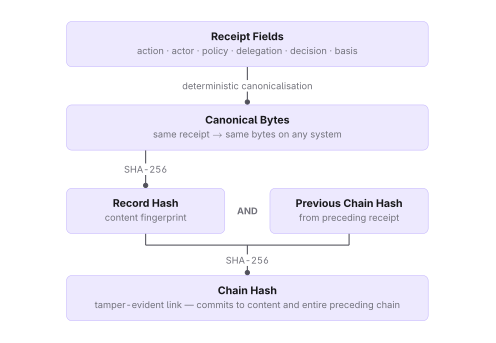
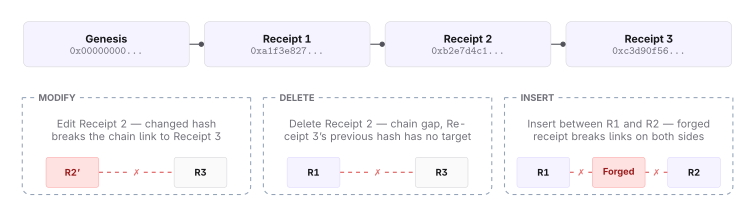
This structure provides three tamper-detection properties. Modification of any receipt breaks the hash computation for the next receipt — the stored prev_hash will not match the recomputed hash. Deletion of any receipt creates a gap — the prev_hash of the next receipt references a record that no longer exists. Insertion of a receipt between two existing records produces hash mismatches on both sides — the new record’s prev_hash matches its predecessor, but the original successor’s prev_hash still references the original predecessor.
Independent reconstructability. The receipt contains sufficient information to reconstruct the decision without the originating system. An auditor who obtains a receipt and the referenced policy and ontology bundles (identified by their content hashes) can assemble the same canonical inputs and replay the evaluation. Replay equivalence — the constitutional requirement that identical inputs produce byte-identical receipts — means the replayed evaluation must produce the same decision, the same rule trace, and the same evidence hashes. Replay uses the preserved resolved inputs exactly as they were materialised during the original resolution phase, including the original timestamp artefact. Runtime metadata that is not deterministic — such as evaluation duration — is excluded from the canonical hashed receipt and therefore does not affect replay equivalence. If replay with preserved inputs does not produce a byte-identical receipt, either the receipt was tampered with or the evaluation was non-deterministic. Both are governance failures.
Over time, the evidence chain transforms governance from an internal operational practice into independently auditable infrastructure. The chain begins at genesis and accrues from that moment forward. Starting the chain later means a new genesis — and the gap between the old chain’s end and the new chain’s beginning is permanent and detectable. There is no way to backfill evidence retroactively without breaking the chain’s integrity properties.
The evidence chain is what makes governance infrastructure, not just a runtime control. A runtime control enforces policy in the moment and leaves no trace. Infrastructure produces durable, independently verifiable artefacts whose integrity can be confirmed by any authorised party. The chain is the output that makes governance real.
11. Why Governance Must Be Independent of AI Vendors
Enterprises deploy autonomous AI systems from multiple vendors, across multiple environments, using frameworks that evolve rapidly. A financial services firm may use one model provider for document analysis, another for customer interaction, and a third for internal workflow automation. These systems interact with the same databases, the same APIs, and the same infrastructure. The governance question — was this action authorised? — must be answerable regardless of which vendor’s model proposed the action.
If governance is coupled to a specific model provider, it inherits that dependency. Change the model and governance semantics may change. Switch providers and governance controls may not transfer. Upgrade a framework and policy enforcement may silently alter. This coupling is not a commercial inconvenience — it is an architectural failure. Governance that changes when the system it governs changes is not governance; it is a feature of the governed system. And features of the governed system are controlled by the governed system’s vendor, not by the organisation that needs the governance.
The independence requirement operates across three dimensions.
Model-neutral. The authorisation layer evaluates canonical actions, not model outputs. The canonical action representation abstracts away model-specific formats, tool-calling conventions, and output structures. Whether the action was proposed by a Claude model, a GPT model, an open-source model, or a model that does not yet exist, the authorisation plane receives the same canonical representation: actor, intent, target, parameters, delegation, policy identity. The evaluation is indifferent to the model’s identity. It evaluates the action.
Framework-neutral. Governance semantics must be invariant across SDKs, toolchains, and orchestration frameworks. The Governance Constitution (Clause 9) requires that replacing a provider, framework, or infrastructure component must not change authorisation outcomes in the absence of an explicit policy change. This means the canonical vocabulary, the evaluation logic, and the evidence format must not depend on any specific framework’s conventions, lifecycle hooks, or integration patterns. If a framework upgrade silently alters what is allowed, governance is not framework-neutral and cannot be honestly audited as a stable control.
Runtime-neutral. The authorisation layer must operate wherever the action boundary exists — in cloud environments, on-premise infrastructure, at the edge, in containers, in serverless functions. The evaluation function’s behaviour must not depend on the runtime environment. A decision rendered on one infrastructure must be identical to the decision rendered on any other infrastructure, given the same inputs. This is a direct consequence of determinism (Section 6): if the evaluation function is pure, its output depends only on its inputs, not on where it runs.
There is a deeper structural argument. The entity being governed should not also control the governance mechanism. This is not a novel principle — it is the foundation of auditing, regulatory compliance, and institutional governance across every regulated industry. Financial auditors must be independent of the firms they audit. Regulatory bodies must be independent of the industries they regulate. The same structural requirement applies to the governance of autonomous AI action. If the governance mechanism is provided by the same vendor that provides the reasoning system, the vendor controls both what the system does and what it is allowed to do. Separation of concerns at the organisational level — not just the architectural level — requires that governance be independent.
Governance must outlast the systems it governs. Model providers will be replaced. Frameworks will evolve. Runtimes will change. The governance layer — with its evidence chain, its policy history, its delegation records — must survive these transitions. An evidence record produced under one vendor’s model must remain interpretable, replayable, and verifiable after that vendor has been replaced. This is only possible if the governance layer is architecturally independent of the systems it governs.
Independence is not a strategic positioning choice. It is a structural requirement of any governance layer that claims to be durable.
12. Evolution Toward an Authorisation Layer
Sections 1 through 11 have established what governance of autonomous AI action requires and why it must be independent. The architectural argument is complete. This section makes the historical argument: these requirements converge on an independent authorisation layer, and the convergence follows a trajectory the technology industry has traversed before.
12.1 The Pattern
Every major infrastructure layer follows the same trajectory: a capability begins embedded in applications, separates into a standalone product, converges on a platform standard, and becomes infrastructure so fundamental that serious systems cannot operate without it.
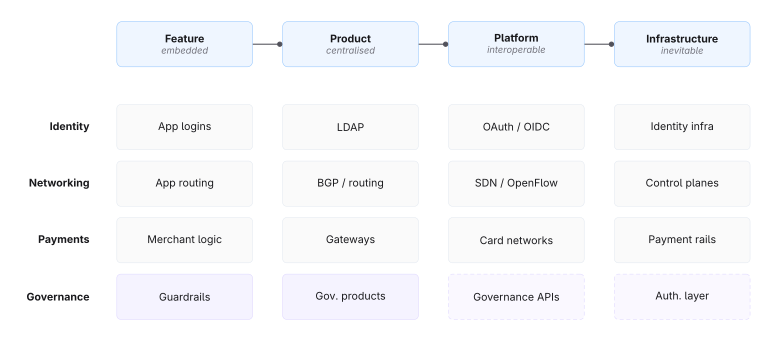
Each transition is driven by the same structural forces: heterogeneity demands neutrality (the capability must work across diverse systems), audit demands evidence (decisions must be provable), scale demands automation (manual processes cannot keep pace), and trust demands independence (the control mechanism must be independent of the systems it controls). These forces apply to governance of autonomous AI action with the same structural pressure they applied to identity, networking, orchestration, and payments.
12.2 Identity
The login screen began as an application feature. Each application managed its own user database, its own authentication logic, and its own session management. In the 1990s, directory services like LDAP externalised identity into standalone products — centralised user stores that multiple applications could authenticate against. OAuth and OpenID Connect transformed identity into a platform standard: federated, token-based, and interoperable across vendors. Today, identity is foundational infrastructure. No serious application is built without it. No enterprise operates without an identity provider. The question “do you have identity infrastructure?” is rhetorical — the answer is always yes.
The key transition: identity separated from the application and became an independent service. Before the separation, every application reinvented authentication — each with its own user table, its own password hashing, its own session management, and its own vulnerabilities. After separation, applications delegated identity to a shared, auditable, standards-based layer. The arguments against separation were familiar: “our application’s identity needs are unique,” “we cannot afford the integration overhead,” “it is simpler to manage our own users.” These arguments lost. The structural forces — heterogeneity, audit, scale, trust — made separation inevitable. First embedded control, then centralised control, then neutral infrastructure.
12.3 Networking
Networking protocols began embedded in application logic. Early networked applications managed their own routing, connection handling, and protocol negotiation. BGP and standardised routing protocols externalised network decision-making into dedicated infrastructure. Software-defined networking (SDN; McKeown et al., 2008) abstracted the network control plane from the data plane: routing decisions are made by a centralised controller, and network devices execute those decisions without making independent routing judgements. Today, programmable network infrastructure is a standard architectural primitive. The control plane is independent of the data path.
The key transition: routing logic separated from application code and became an independent control plane. Before SDN, every network device made its own forwarding decisions based on locally maintained routing tables. After SDN, a centralised controller renders forwarding decisions, and network devices execute them. The SDN pattern — deciding independently, executing separately — is structurally identical to the three-plane architecture described in Section 5.
12.4 Container Orchestration
Deployment logic began as shell scripts and ad-hoc automation. Configuration management tools — Chef, Puppet, Ansible — externalised deployment into standalone products. Kubernetes transformed container orchestration into a platform: declarative, self-healing, and vendor-neutral. Today, Kubernetes is infrastructure. The question is not whether to use container orchestration but which implementation to deploy.
The key transition: deployment logic separated from applications and became declarative infrastructure. Before separation, deploying an application meant writing bespoke scripts that encoded operational knowledge in imperative procedures. After Kubernetes, applications declare their desired state, and the orchestration layer converges the actual state toward it. The governance analogy is direct: autonomous AI systems propose actions; the authorisation layer ensures that only authorised actions execute.
12.5 Payments
Payment processing began embedded in merchant applications. Each merchant managed its own payment logic, fraud detection, and settlement — a fragmented landscape where every point of sale was an island. Payment gateways externalised processing into standalone products. Visa, Mastercard, and the card network infrastructure transformed payments into a platform: standardised, interoperable, and trust-bearing. Today, payment infrastructure is foundational. Every transaction flows through an authorisation network that evaluates the transaction, renders a decision (approve or decline), and produces a record — before the transaction executes.
The structural parallel to governance of autonomous AI action is the most precise of the four analogies. A customer presents a card (delegation artefact). The merchant submits the transaction (proposed action). The card network evaluates it against the cardholder’s account constraints (policy evaluation). The network renders an authorisation decision (ALLOW or DENY). The decision is recorded (evidence). The merchant can only execute the transaction if the network authorises it (pre-execution governance). The receipt proves the authorisation occurred (evidence-bound governance). Replace “customer” with “human principal,” “card” with “delegation token,” “merchant” with “autonomous AI system,” and “card network” with “authorisation layer,” and the architecture is identical.
The key transition: payment authorisation separated from merchants and became an independent network. Before the separation, each merchant made its own credit decisions — with predictable consequences for fraud and trust. After it, an independent network rendered authorisation decisions before transactions executed, and the evidence record proved to all parties that governance occurred. First embedded control, then centralised control, then neutral infrastructure.
12.6 Governance of Autonomous AI Action
Governance of autonomous AI action is currently transitioning through the same trajectory.
Feature stage (current dominant pattern). Guardrails embedded in frameworks, application-level checks, prompt engineering constraints. Governance logic is coupled to specific models, frameworks, and applications. Each deployment reinvents its controls. There is no shared vocabulary for describing actions, no standard format for policy, and no mechanism for producing evidence that governance occurred. This is where most enterprise deployments sit today — functionally equivalent to the era when each application managed its own user database.
Product stage (emerging). Policy engines, governance platforms, and centralised rule systems that externalise governance from individual applications. Controls become configurable and auditable, but remain coupled to specific vendor ecosystems or framework integrations. An organisation using a governance product can demonstrate that it has policies, but the policies may not be independently verifiable, the evidence may not survive vendor changes, and the governance semantics may be implicitly coupled to a specific model provider or framework version. This stage parallels the LDAP era of identity: centralised but not yet federated, useful but not yet infrastructure.
Platform stage (near-term). Standardised governance interfaces, canonical action vocabularies, and interoperable policy formats. Governance becomes vendor-neutral and composable across systems. Multiple autonomous AI systems from different providers are evaluated against a single compiled policy using a shared canonical vocabulary. Evidence records become interoperable — a receipt produced by one deployment is structurally identical to a receipt produced by another. This stage parallels the OAuth/OIDC moment for identity: the point where federation and interoperability become expected properties rather than differentiating features.
Infrastructure stage (destination). The authorisation layer for autonomous AI action becomes foundational — a standard architectural component without which autonomous AI systems cannot credibly operate. Evidence chains become auditable infrastructure. Governance receipts become the proof artefacts that regulators, auditors, and counterparties require. The question “do you have governance infrastructure?” becomes as rhetorical as “do you have identity infrastructure?” Not having it is not a competitive disadvantage — it is a disqualification from regulated markets, enterprise procurement, and high-stakes deployment.
12.7 Common Structural Forces
The same four forces drove every prior transition. They are now driving governance.
Heterogeneity demands neutrality. Enterprises deploy autonomous AI systems from multiple vendors, using multiple frameworks, across multiple environments. Governance that is coupled to one vendor cannot govern the others. The governance layer must be neutral across the ecosystem it governs — the same structural force that drove identity from per-application databases to federated protocols.
Audit demands evidence. Regulatory and institutional requirements demand proof, not assertion. “We have policies” is insufficient; “here is cryptographic proof the policy was evaluated” is required. The governance layer must produce durable, independently verifiable evidence — the same structural force that drove financial transaction processing from merchant records to network-level authorisation receipts.
Scale demands automation. Autonomous AI systems execute hundreds or thousands of actions per minute. Manual review cannot keep pace. Governance evaluation must be automated, deterministic, and real-time — the same structural force that drove network routing from manual configuration to software-defined control planes.
Trust demands independence. The governance mechanism must be independent of the systems it governs. A model provider that also controls the governance mechanism controls both the actor and the rules — an untenable concentration. The governance layer must be organisationally and architecturally independent — the same structural force that drove financial auditing to require independent auditors.
The TRIZ S-curve model provides a complementary lens. The current ecosystem is transitioning from Stage 1 (framework-embedded governance, characterised by rapid feature accumulation and vendor differentiation) through Stage 2 (product governance, characterised by centralisation, configurability, and vendor-specific platforms) to Stage 3 (platform governance, characterised by standardisation, consolidation, and interoperability). Stage 4 (infrastructure governance, characterised by ubiquity, commoditisation, and foundational status) is the destination. The trajectory is not speculative. It is the same structural trajectory that every major infrastructure layer has followed.
The question is not whether governance of autonomous AI action separates into an independent layer. It is when.
13. The Control Plane for Autonomous AI Systems
The three-plane separation described in Section 5 positions the authorisation layer as a control plane for autonomous AI action. This is a structural parallel, not a metaphor — the same architectural pattern recurs wherever systems grow complex enough that deciding must be separated from executing.
Control plane / data plane separation is the defining architectural pattern of scalable infrastructure:
| Domain | Control Plane | Data Plane |
|---|---|---|
| Networking | SDN controller | Network switches and routers |
| Cloud orchestration | Kubernetes API server | Container runtimes and nodes |
| Identity | OAuth/OIDC provider | Application sessions and tokens |
| Payments | Card network (Visa, Mastercard) | Point-of-sale terminals and merchant systems |
| Autonomous AI action | Authorisation layer | Reasoning and execution systems |
In every case, the control plane shares the same properties: it is independent of the data path (routing decisions are not made by routers in SDN; authorisation decisions are not made by models in governance). It applies deterministic decision semantics (given the same routing table and packet header, the same forwarding decision; given the same policy and canonical action, the same authorisation decision). It is observable and auditable (routing tables can be inspected; evidence chains can be verified). And it survives replacement of individual components (replacing a switch does not change routing policy; replacing a model does not change governance policy).
The authorisation layer for autonomous AI action exhibits all four properties. It is independent of the reasoning and execution systems it governs. It renders deterministic decisions based on compiled policy and canonical inputs. Its evidence chains are independently verifiable. And it survives the replacement of any individual model, framework, or runtime — because its evaluation is defined by policy, not by the systems it evaluates.
The pattern recognition matters because it makes the architecture immediately comprehensible to the audience that funds, deploys, and operates enterprise infrastructure. An executive who understands SDN understands that network decisions should not be made by individual switches. An executive who understands payment networks understands that transaction authorisation should not be embedded in merchant applications. The same executive can understand that governance decisions for autonomous AI action should not be embedded in the reasoning systems that propose those actions. The authorisation layer is not a security tool bolted onto autonomous AI systems. It is the control plane that makes autonomous AI action governable.
The naming also clarifies what governance is not. Governance is not a feature of the reasoning system (any more than routing is a feature of a web server). Governance is not a monitoring layer that observes actions after the fact (any more than SDN is a packet capture tool). Governance is not a guardrail that constrains model outputs (any more than a firewall is a content filter). Governance is the control plane: the independent, deterministic, evidence-producing layer that decides whether proposed actions proceed. Every other characterisation collapses the control plane into the data plane — and every such collapse produces the same structural failure: the governed system controls its own governance.
14. The Ambit Infrastructure Vision
The trajectory described in the preceding sections converges on a single destination: the authorisation layer for autonomous AI action. Ambit’s vision is to build that layer.
The destination is not a product. It is an inevitability.
Autonomous AI systems can scale only if authorisation becomes infrastructure. Three structural pressures make this convergence unavoidable, and they are accelerating simultaneously.
Capability pressure. Models become more powerful with each generation. Each increase in capability widens the action space — more tools, more complex delegation chains, more coordination topologies, more categories of consequence. The governance gap does not shrink as capability grows. It widens.
Risk pressure. Enterprises deploying autonomous AI systems in consequential domains — financial services, healthcare, infrastructure, government — require deterministic guarantees about action authorisation. A system that can move money, modify patient records, or alter infrastructure without verifiable authorisation is not deployable in any regime that demands accountability.
Regulatory pressure. Regulatory frameworks increasingly require not just policy but proof. The regulatory trajectory — from principles to requirements to enforcement — follows the same path that drove financial transaction processing from merchant assertions to network-level authorisation receipts.
These pressures do not create demand for a product. They create demand for infrastructure. Any serious autonomous AI system will eventually require an independent authorisation layer — for the same structural reasons that every serious application requires identity infrastructure, every serious network requires a control plane, and every serious financial transaction requires an authorisation network.
The governance of autonomous AI action will converge on an independent authorisation layer. Not because a company chooses to build it, but because the architecture of autonomous systems leaves no alternative. The question is not whether this layer will exist. It is who builds it, and whether the organisations that need it recognise the requirement in time.
The Governance Constitution encodes the invariants that the authorisation layer must satisfy:
No action without evaluation. No evaluation without delegation. No delegation without scope. No decision without evidence. No evidence without integrity. No composition without governance.
That is the governance contract. It is not optional — it is the structural requirement of any system that must be simultaneously autonomous and governed. The authorisation layer is the mechanism that satisfies it.
Ambit Systems exists to build that mechanism.
Selected References
Altshuller, G.S. (1999). The Innovation Algorithm: TRIZ, Systematic Innovation and Technical Creativity. Technical Innovation Center, Worcester, MA.
Dennis, J.B. & Van Horn, E.C. (1966). “Programming Semantics for Multiprogrammed Computations.” Communications of the ACM, 9(3), 143–155.
Hardy, N. (1988). “The Confused Deputy: (or why capabilities might have been invented).” ACM SIGOPS Operating Systems Review, 22(4), 36–38.
McKeown, N., Anderson, T., Balakrishnan, H., Parulkar, G., Peterson, L., Rexford, J., Shenker, S. & Turner, J. (2008). “OpenFlow: Enabling Innovation in Campus Networks.” ACM SIGCOMM Computer Communication Review, 38(2), 69–74.
Saltzer, J.H. & Schroeder, M.D. (1975). “The Protection of Information in Computer Systems.” Proceedings of the IEEE, 63(9), 1278–1308.